
By Lara Kajs
Thinking Out Loud
As the war in Gaza intensifies, questions about the limits of military force and the path to lasting peace have taken on renewed urgency. This piece examines the strategic, legal, and humanitarian implications of large-scale bombardment—and whether it can ever achieve the security outcomes it claims to deliver.
Peace is not passive—it is a deliberate, sustained choice. It cannot be imposed through force, nor achieved through destruction. States do not bomb their way to legitimacy, and populations do not emerge from violence more inclined toward reconciliation. Peace requires political will, accountability, and engagement, even among adversaries.
Over the past decade, conflicts across Syria, Yemen, Iraq, Afghanistan, Ukraine, Sudan, and Gaza have demonstrated a recurring pattern: the use of overwhelming force with the expectation that it will produce stability. Yet the historical record suggests otherwise. When bombardment ends, what often remains is not peace, but devastation—and the conditions for future conflict.
Peace is not passive—it is a deliberate, sustained choice. It cannot be imposed through force, nor achieved through destruction.”
Defend or Destroy?
The debate surrounding the war between Israel and Hamas has centered on the balance between a state’s right to self-defense and the limits imposed by international humanitarian law.
Israel maintains that dismantling Hamas’s military capabilities is necessary to prevent future attacks. However, the methods employed—and the scale of destruction—raise serious legal and strategic questions. Armed groups operating within civilian areas present profound operational challenges, but they do not nullify the obligation to distinguish between combatants and civilians, nor to ensure proportionality in the use of force.
Extensive destruction of civilian infrastructure and high civilian casualty rates risk undermining long-term security objectives. Rather than neutralizing threats, such approaches can contribute to cycles of grievance, radicalization, and prolonged instability.
Civilian Harm and Strategic Consequences
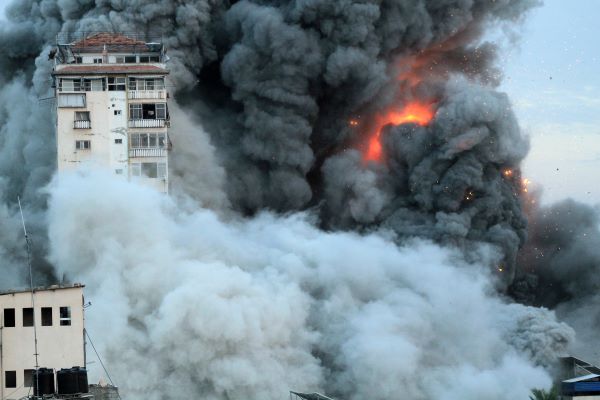
Available reporting indicates a high volume of airstrikes in densely populated areas of Gaza, including the use of unguided munitions, which increase the risk to civilians. At the same time, casualty figures suggest a significant disparity between intended military targets and the scale of civilian harm.
Beyond the immediate human toll, the strategic consequences are profound. Widespread destruction, mass casualties, and displacement are not contained events—they are witnessed, documented, and internalized, shaping perceptions for generations. In an era of constant surveillance and digital documentation, the long-term impact of such actions extends far beyond the battlefield.
Internal Displacement and Humanitarian Crisis
The humanitarian situation in Gaza has reached critical levels. Millions of civilians have been displaced, many with limited or no access to clean water, medical care, or adequate shelter. Infrastructure essential to civilian survival—including hospitals and water systems—has been severely degraded.
Humanitarian conditions of this scale are not only a moral concern but a strategic one. Prolonged deprivation and insecurity create environments in which instability deepens, and recovery becomes increasingly difficult.
Political Solutions and the Limits of Force
At the core of the Israeli–Palestinian conflict lies an unresolved political question: the status, rights, and self-determination of the Palestinian people.
A two-state solution continues to be widely cited as a viable framework for long-term peace, though its feasibility has become increasingly contested. Regardless of the specific political outcome, it is clear that military force alone cannot resolve fundamentally political grievances.
Efforts to achieve lasting security must address underlying issues, including governance, territorial claims, and mutual recognition. Without this, cycles of violence are likely to persist.
The Bottom Line
Military force can degrade capabilities, but it cannot create peace. Indiscriminate and unaccountable bombing cannot resolve political disputes, rebuild trust, or address the conditions that give rise to conflict.
The continued reliance on large-scale bombardment as a pathway to security reflects a fundamental miscalculation—one that has been repeated across conflicts and continues to produce the same result: prolonged instability.
You cannot bomb your way to peace. If peace is the objective, then diplomacy, restraint, and sustained political engagement are not optional—they are essential.
Published 18 January 2024
Photo Credit: Damage in Gaza Strip, by Wafa (Q2915969) in contract with a local company (APAimages) is licensed under CC by SA 3.0.
About Thinking Out Loud
Thinking Out Loud is a commentary series by Lara Kajs examining international law, humanitarian crises, and the prevention of mass atrocities. Drawing on field experience in conflict and displacement settings, the column explores the legal and policy challenges that shape contemporary conflicts
About the Author
Lara Kajs is the founder and executive director of The Genocide Report, a Washington, DC-based educational nonprofit focused on atrocity prevention and international law. She is the author of several field-based books on conflict, displacement, humanitarian crises, and international humanitarian law, drawing on extensive research and field experience in Yemen, Syria, and Afghanistan. Her writing and public speaking focus on atrocity crimes, forced displacement, the protection of civilians, and the legal frameworks governing armed conflict.