Lara Kajs
Thinking Out Loud
The protection of journalists is a foundational component of both human rights and atrocity prevention frameworks. Yet the global environment for press freedom has deteriorated sharply, with increasing patterns of targeted violence, legal harassment, and impunity. The cases of Amal Khalil, Shireen Abu Akleh, and Marie Colvin illustrate how these dynamics operate in practice—where legal protections exist in principle, but enforcement remains inconsistent, and accountability is often absent.
Press freedom is often described as a cornerstone of a democratic society. In conflict environments, it is something more urgent: a mechanism of visibility, accountability, and in some cases, survival. Journalists operating in these spaces do not simply report events—they document patterns of harm, preserve evidence, and make it more difficult for atrocities to unfold in silence.
Yet the global landscape in 2026 reflects a sharp and accelerating decline in the conditions necessary for independent journalism. While international legal frameworks protecting journalists remain formally intact, their practical application has weakened. Increasingly, the threat is not only physical violence, but the systematic use of legal, political, and technological tools to suppress reporting. The result is a narrowing of the space in which journalists can operate, and a corresponding reduction in the world’s ability to see, understand, and respond to emerging crises.
A Global Decline in Press Freedom
Recent findings from Reporters Without Borders indicate that for the first time, more than half of the world’s countries are classified as having “difficult” or “very serious” conditions for press freedom. The most significant deterioration has occurred within the legal domain, where approximately 60 percent of countries have experienced a worsening environment.
This shift reflects a broader transformation in how press freedom is constrained. While violence against journalists remains a persistent threat, there has been a notable expansion in the use of legal mechanisms to suppress reporting. Strategic lawsuits against public participation (SLAPPs), expansive national security laws, defamation statutes, and surveillance technologies are increasingly deployed to intimidate, silence, or discredit journalists.
Importantly, this trend is not confined to authoritarian systems. Countries traditionally viewed as stable democratic environments have also experienced measurable decline. The United States, for example, has seen a drop in global rankings, with assessments citing increasing hostility toward the press. Across parts of Latin America, including Argentina and El Salvador, political rhetoric and policy shifts have contributed to a more restrictive environment for journalists.
The Middle East remains among the most dangerous regions for media professionals. In Palestine, high casualty rates among journalists underscore the risks associated with reporting in active conflict zones. While political transitions in Syria have led to modest improvements in press conditions, these gains remain fragile and uneven.
What emerges is not a single pattern, but a convergence of pressures—legal, political, and physical—that collectively constrain the ability of journalists to operate freely.
Targeted Risk: Three Cases
The erosion of press freedom is not abstract. It is reflected in the lived experiences and, in many cases, the deaths of journalists working in conflict environments.
In April 2026, Lebanese journalist Amal Khalil, a reporter for Al-Akhbar, was killed in an Israeli airstrike in southern Lebanon. Khalil had been covering ongoing strikes in the region when an initial blast injured her. After seeking shelter in a nearby house, the location was struck again in what has been described as a “double tap” attack—a tactic that has been widely criticized for endangering both victims and first responders.
Efforts to reach Khalil were significantly delayed, and reports indicate that an ambulance associated with the International Committee of the Red Cross came under fire while attempting to provide assistance. While the Israeli military stated that it does not target journalists and that the incident would be investigated, this is not the first time the Israeli government has been accused of targeting journalists. The circumstances surrounding her death have raised serious concerns regarding the protection of media personnel in active conflict zones.
In May 2022, Shireen Abu Akleh, a veteran correspondent for Al Jazeera, was killed while reporting on a military raid in the West Bank. She was wearing clearly marked press identification at the time of her death. Multiple independent investigations, including those conducted by the United Nations, have concluded that the fatal shots were fired by an Israeli soldier.
Further analysis by organizations such as Al-Haq and Forensic Architecture, as well as an investigation by the U.S., suggested that the shooting was not incidental but targeted. Despite these findings, no criminal accountability has been established. The absence of prosecution has contributed to Akleh’s enduring symbolic significance in discussions of press freedom and impunity.
A decade earlier, in February 2012, American war correspondent Marie Colvin was killed in Homs, Syria, while reporting on the siege of civilian populations. The media center in which she was working was struck by Syrian government artillery. Subsequent legal proceedings in a U.S. federal court determined that the attack had been deliberate, with evidence indicating that Syrian forces had targeted journalists by tracking their broadcast signals.
Colvin’s case remains one of the few in which a formal legal judgment recognized the intentional targeting of a journalist. Yet even here, accountability has been limited in practical terms.
Taken together, these cases reflect a broader pattern: journalists are not only exposed to the general risks of conflict—they are, in some instances, directly targeted. And in the vast majority of cases, those responsible face no consequences.
Legal Protections: Framework and Failure
International law provides a clear framework for the protection of journalists. Under Article 79 of Additional Protocol I to the Geneva Conventions, journalists operating in conflict zones are considered civilians, provided they take no direct part in hostilities. This designation affords them protection from direct attack under the same legal frameworks that apply to the civilian population.
Like humanitarian workers, journalists are not armed, do not fight in conflict, and are not part of military operations. This distinction is not symbolic—it is central to how international law defines and protects them.
Similarly, United Nations Security Council Resolution 1738 explicitly condemns attacks against journalists in conflict situations and reaffirms the obligation of all parties to respect their protected status.
On paper, these protections are unambiguous. In practice, enforcement remains inconsistent and often ineffective.
The gap between legal obligation and operational reality is evident in the high number of journalist casualties in contemporary conflicts. In environments where accountability mechanisms are weak or politically constrained, violations of international humanitarian law may occur without meaningful consequence.
This gap is further compounded by the use of domestic legal systems to restrict journalism. Laws framed around national security, counterterrorism, or defamation are increasingly applied in ways that limit reporting rather than protect public safety. Surveillance technologies and digital monitoring add another layer of risk, enabling states and non-state actors alike to track, intimidate, or detain journalists.
The result is a dual pressure: physical danger in the field and legal vulnerability outside it.
The Role of Journalism in Atrocity Prevention
The erosion of press freedom has implications that extend beyond the media sector. It directly affects the international community’s capacity to identify, respond to, and prevent mass atrocities.
Journalists play a critical role in what can be understood as three interconnected pathways of prevention. First, they contribute to structural prevention by supporting transparency, accountability, and the rule of law. Second, they enable operational prevention by identifying early warning signs of escalating violence. Third, they support crisis response by documenting ongoing violations and providing evidence that can inform humanitarian and legal action.
Historical and contemporary examples illustrate this role. In Myanmar, reporting on violence in Rakhine State contributed to international awareness and informed proceedings before the International Court of Justice. In other contexts, the absence of reliable reporting has allowed violence to escalate with limited external scrutiny.
At its core, journalism functions as a form of witnessing. It records what is happening, who is affected, and how patterns of harm develop over time. When that function is disrupted—whether through violence, legal restriction, or intimidation—the ability to respond to an emerging crisis is diminished.
When journalists are targeted and silenced, it is not only the individual voice that is lost—it is the evidence, the accountability, and the possibility of response.”
The Bottom Line: Visibility and Accountability
The decline in press freedom is not only a media issue. It is a structural challenge with direct implications for civilian protection and international accountability.
Across contexts, an estimated 90 percent of cases involving violence against journalists remain unresolved. This level of impunity weakens deterrence and contributes to an environment in which targeting or suppressing journalists carries limited risk.
Protecting journalists requires more than reaffirming legal principles. It requires consistent enforcement, credible accountability mechanisms, and a recognition that press freedom is integral to broader efforts to prevent and respond to mass atrocities.
When journalists are silenced, the consequences extend beyond individual loss. Entire narratives disappear. Patterns go undocumented. And the space for accountability narrows.
The question is not whether the world values press freedom in principle. The question is whether it is willing to protect the people who make that freedom possible.
Published: 3 May 2026
Photo Credit:
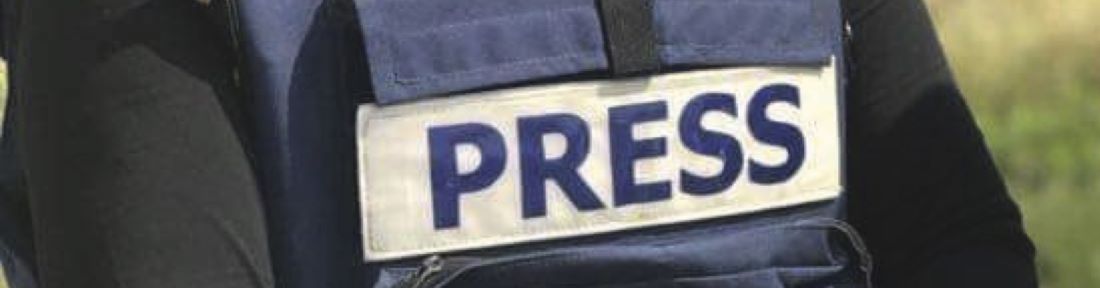
Bullet-resistant “PRESS” vest worn by journalists in conflict zones—LKajs photo.
About Thinking Out Loud
Thinking Out Loud is a commentary series by Lara Kajs examining international law, humanitarian crises, and the prevention of mass atrocities. Drawing on field experience in conflict and displacement settings, the column explores the legal and policy challenges that shape contemporary conflicts.
About the Author
Lara Kajs is the founder and executive director of The Genocide Report, a Washington, DC-based educational nonprofit focused on atrocity prevention and international law. She is the author of several field-based books on conflict, displacement, humanitarian crises, and international humanitarian law, drawing on extensive research and field experience in Yemen, Syria, and Afghanistan. Her writing and public speaking focus on atrocity crimes, forced displacement, the protection of civilians, and the legal frameworks governing armed conflict.