Lara Kajs
Thinking Out Loud
Washington, DC — 5 November 2026
The United Nations is approaching a leadership transition at a moment when its credibility is under extraordinary strain. Wars continue to devastate civilian populations, humanitarian access is restricted or politicized, and governments that invoke international law may also be accused of undermining it. The next Secretary-General will inherit an institution expected to mediate conflicts, defend the principles of the UN Charter, and respond to crises even when its most powerful members are unwilling to act.
The selection of the next Secretary-General is therefore more than a contest for the organization’s highest office. It is an opportunity to examine what kind of leadership the United Nations needs—and whether its member states are prepared to choose someone capable of exercising it independently.
What the Secretary-General Can—and Cannot—Do
The Secretary-General is the UN’s chief administrative officer and its most visible diplomatic representative. The position carries responsibility for managing the Secretariat, bringing urgent matters to the attention of the Security Council, supporting negotiations, mediating disputes, and speaking publicly on threats to international peace and security. The office can convene, persuade, warn, and help create the conditions for political agreement.
But the Secretary-General does not command the United Nations as a world government. The organization’s authority remains constrained by its member states, particularly the Security Council’s five permanent members, whose veto power can block substantive Council action. The General Assembly appoints the Secretary-General on the Security Council’s recommendation, making the selection process inseparable from the political interests of the states that shape it.
This is the central tension of the office: the Secretary-General must represent the purposes and principles of the UN Charter while operating within a system in which governments frequently place national interests ahead of collective responsibility. The ability to navigate that tension without surrendering institutional independence is among the most important qualifications for the position.
“The Secretary-General’s responsibility is not to be free of political pressure, but to demonstrate the independence and judgment to act despite it.”
Lana Nusseibeh’s Candidacy and the Question It Raises
On 21 October, the United Arab Emirates nominated Lana Zaki Nusseibeh, a senior Emirati diplomat and former permanent representative to the United Nations, as a candidate to succeed António Guterres. Her nomination came after the selection process had already progressed through candidate dialogues and Security Council straw polls. She subsequently participated in an interactive dialogue with member states and civil society on 27 October. Although candidates may be nominated at different stages of the process, the timing and political support behind her candidacy warrant attention.
Nusseibeh brings substantial diplomatic experience. For more than a decade, she represented the UAE at the UN, working on institutional reform, peace and security, and humanitarian diplomacy. She played an important role in the negotiations that produced Security Council Resolution 2720 in December 2023, establishing a UN mechanism intended to facilitate humanitarian aid into Gaza. Her diplomatic record and stated commitment to conflict prevention and more effective multilateral action deserve serious consideration.
At the same time, the government backing her candidacy has significant economic, diplomatic, and security interests across the Middle East and Africa. Its regional partnerships—and allegations concerning its involvement in armed conflicts—raise questions relevant to the independence expected of the next Secretary-General.
Sudan is an especially serious example. The UAE has been repeatedly accused of providing military support to the Rapid Support Forces (RSF), the paramilitary force fighting Sudan’s national army since April 2023. Investigative reporting, arms investigations, and statements by US lawmakers have added to those concerns. The UAE denies arming the RSF and rejects allegations that it is fueling the conflict. Those denials must be acknowledged, but they do not eliminate the need for independent scrutiny of credible evidence concerning external support for the warring parties.
Nusseibeh served as a senior UAE representative during years in which the country’s position on Sudan was contested internationally. Her diplomatic role does not establish personal responsibility for alleged state conduct. The more consequential question is whether, as Secretary-General, she could address credible evidence impartially when doing so might challenge the interests of the government that nominated her.
The UAE’s close security partnership with Ethiopia raises further questions about the regional interests surrounding its candidacy. The Emirates supplied significant military assistance to the Ethiopian government during the Tigray war, according to security analyses. Ethiopia’s internal conflicts and regional tensions, including its deteriorating relations with Eritrea, demonstrate how external partnerships can influence the course of instability. These relationships do not establish wrongdoing by Nusseibeh. They do, however, make it important to understand the political interests that may shape expectations of her leadership.
A Woman Secretary-General
There is a compelling case for appointing a woman Secretary-General. In more than eighty years, the United Nations has never had a woman in the position. For an organization that has made gender equality and women’s participation central to its public commitments, that absence is difficult to justify.
I support the appointment of a woman. But the historic significance of that achievement must be accompanied by the qualities the office demands: independence, integrity, political judgment, and a demonstrated commitment to human rights and the UN Charter. Representation and qualifications are not competing goals. The first woman to hold the position should be able to lead on merit and be judged by the same standards applied to every candidate.
That principle also requires a selection process that looks beyond diplomatic endorsements and political momentum. The question is not whether Nusseibeh’s late nomination is procedurally improper; it is not prohibited under the current process. It is whether all candidates receive meaningful scrutiny and whether member states are prepared to examine their records, relationships, and capacity for independent leadership.
Where the United Nations Is Needed Most
The deeper question is what kind of leadership the world needs from the United Nations now.
The organization is needed in Sudan, where civilians face mass displacement, hunger, and atrocities; in Ethiopia, where unresolved conflicts and regional tensions threaten renewed instability; in Yemen, where years of war have left millions dependent on humanitarian assistance; and in Gaza, where civilian protection and access to essential aid remain urgent concerns. It is also needed in Afghanistan, Myanmar, Lebanon, and Syria, where repression, displacement, fragile political arrangements, and the consequences of armed conflict demand sustained international attention.
These crises require a different combination of diplomacy, humanitarian engagement, political pressure, and respect for international law. But they share one essential requirement: the UN must engage governments and armed actors without letting powerful states’ interests determine whose suffering receives attention and whose violations are challenged.
The Secretary-General cannot impose peace where parties refuse to negotiate, compel the Security Council to overcome a veto, or guarantee that a ceasefire will hold. The office can, however, press for civilian protection, support credible mediation, raise threats to international peace and security, and insist that humanitarian access and legal obligations are not merely bargaining chips. It can also help keep crises on the international agenda when they become politically inconvenient.
Meeting those responsibilities requires more than diplomatic skill. It requires a leader whose judgment is trusted across regions and political divides, and whose willingness to uphold the Charter does not depend on the identity or influence of the government involved.
The Test Is Independence
The next Secretary-General will take office in January 2027 amid profound questions about the UN’s ability to deliver on its founding promises. The selection process cannot resolve every structural weakness in the organization. The Security Council’s veto, competing national interests, and the absence of consistent political will will continue to constrain what the UN can do.
But the choice of leader still matters. The person appointed must manage the organization effectively, mediate without surrendering principle, defend the Charter consistently, and address credible allegations of abuse even when influential governments are implicated.
A woman Secretary-General would mark an important institutional milestone. Its significance, however, will ultimately depend on the leadership that follows; whether the person selected can confront the realities of power rather than accommodate them.
The United Nations does not need a Secretary-General free of political constraints; no candidate could meet that standard. It needs one who understands those constraints and refuses to mistake them for permission to remain silent. At a time when civilians in some of the world’s gravest crises cannot rely on their own governments for protection, the next Secretary-General must be prepared to speak clearly, act independently, and uphold the principles of the Charter consistently.
That is the test—not only of an individual candidate, but of the institution she or he seeks to lead.
Photo Credit
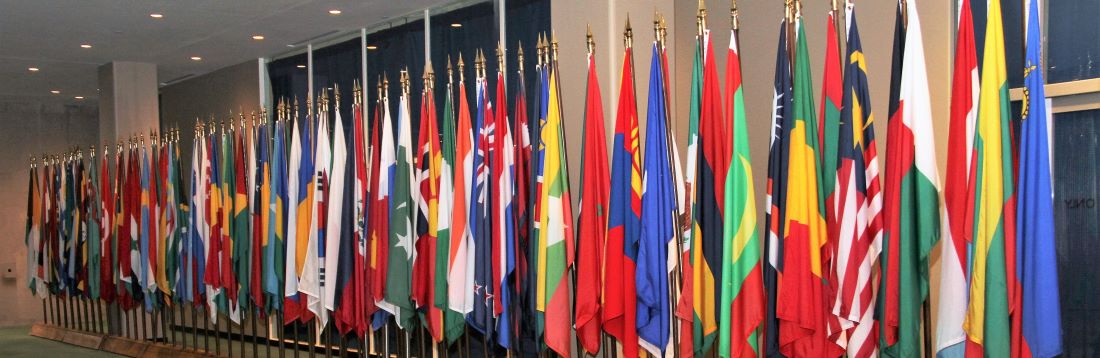
Hallway of Flags in the UN building in New York City, September 20, 2019 by Diplomatic Security Services. Licensed under Public Domain 1.0
About Thinking Out Loud
Thinking Out Loud is a commentary series by Lara Kajs examining international law, humanitarian crises, and the prevention of mass atrocities. Drawing on field experience in conflict and displacement settings, the column explores the legal and policy challenges that shape contemporary conflicts.
About the Author
Lara Kajs is the founder and executive director of The Genocide Report, a Washington, DC-based educational nonprofit focused on atrocity prevention and international law. She is the author of several field-based books on conflict, displacement, humanitarian crises, and international humanitarian law, drawing on extensive research and field experience in Yemen, Syria, and Afghanistan. Her writing and public speaking focus on atrocity crimes, forced displacement, the protection of civilians, and the legal frameworks governing armed conflict.