Lara Kajs
Thinking Out Loud
The introduction of a death penalty framework targeting Palestinians prosecuted in Israeli military courts marks a significant escalation in the legal architecture governing the occupied West Bank. Supporters of the measure frame it as a counterterrorism policy intended to deter attacks against Israeli civilians. Critics argue that it deepens an already fragmented legal system in which Palestinians and Israeli settlers living within the same territory are governed under fundamentally different standards of law and enforcement.
The issue extends beyond capital punishment alone. It raises broader questions regarding occupation law, military courts, unequal legal protections, and the long-term credibility of international humanitarian law under prolonged military occupation. While public debate often focuses narrowly on security and deterrence, the deeper issue concerns the structure of legal authority itself and whether equal protection can meaningfully exist within systems built on differential governance.
The Architecture of Occupation
Military courts do not exist in isolation. They exist within the broader architecture of occupation itself—a system that has governed Palestinian civilian life in the West Bank for nearly six decades through military administration, territorial fragmentation, movement restrictions, and overlapping legal authorities.
Under international humanitarian law, the West Bank is widely recognized by the United Nations, the International Court of Justice, and most international legal bodies as occupied territory. Palestinians living there are considered protected persons under the Fourth Geneva Convention. This designation imposes legal obligations on the occupying power regarding civilian protection, detention, prosecution, and the administration of justice.
At the same time, the occupation has produced a governance structure in which two populations living within the same territory operate under separate legal systems.
Palestinians in the West Bank are generally prosecuted through Israeli military courts operating under military law. Israeli settlers residing within the same occupied territory remain subject to Israeli civilian law and the Israeli domestic court system. This distinction is not merely procedural. It affects due process protections, detention standards, movement rights, land access, evidentiary rules, sentencing structures, and broader perceptions of legitimacy and accountability.
The result is a system in which legal authority is exercised unevenly across populations living under the same territorial control.
Military Courts and Differential Enforcement
Military courts have become one of the defining instruments of the occupation structure in the West Bank. Israeli authorities argue that the system is necessary to address ongoing security threats and prevent attacks against civilians amid a prolonged conflict environment. Critics, however, contend that the issue is no longer simply one of temporary security administration.
Over time, the military court system has evolved into a permanent mechanism of governance operating alongside a separate civilian legal framework for Israeli settlers living within the same territory.
Human rights organizations and legal observers have repeatedly raised concerns regarding due process protections, reliance on classified evidence, high conviction rates, and the extensive use of administrative detention. While Israeli authorities maintain that such measures are necessary to address imminent threats and protect intelligence sources, critics argue that prolonged detention without a transparent judicial process weakens confidence in the neutrality and legitimacy of the system itself.
The debate surrounding military courts, therefore, extends beyond individual prosecutions. The deeper concern is whether legal systems built upon differential standards of enforcement can sustain long-term credibility when different populations living under the same territorial authority experience fundamentally different structures of justice.
The issue is therefore not solely the severity of punishment. It is the coexistence of fundamentally different legal standards operating simultaneously under the same system of territorial authority.
Capital Punishment Under Occupation
The March 2026 Knesset legislation introducing the death penalty for certain terrorism-related offenses prosecuted through military courts has intensified scrutiny of this legal structure.
Historically, Israel has used capital punishment extremely rarely. In total, the State of Israel has carried out exactly two legal executions: Meir Tobianski in 1948 and Adolf Eichmann in 1962. Notably, Meir Tobianski was exonerated posthumously.
The introduction of a death penalty framework connected to military prosecution in the occupied West Bank, therefore, represents a major legal and symbolic shift. Military trials feature a 96% conviction rate and face severe restrictions on appeals.
Supporters of the legislation argue that harsher punishment is necessary to deter attacks and strengthen national security. Within Israel, public support for stronger punitive measures has intensified amid repeated violence, armed attacks, and escalating regional instability.
Yet the legal implications of capital punishment under occupation extend beyond deterrence debates.
The Fourth Geneva Convention does not categorically prohibit the death penalty within occupied territory. However, it imposes strict procedural safeguards and limitations governing criminal prosecution under occupation. Articles 64 through 77 establish protections intended to prevent arbitrary punishment and ensure judicial safeguards for protected populations.
Those safeguards become particularly significant when the legal system itself is already under international scrutiny for unequal protections and differential enforcement.
The death penalty is irreversible. In systems where concerns already exist regarding due process, transparency, or unequal legal treatment, the introduction of irreversible punishment fundamentally alters the legal and moral stakes of prosecution.
The issue is not simply whether military courts possess legal authority to impose punishment. The deeper issue is whether irreversible punishment can be administered fairly within a system with fundamentally different structures of justice.
The issue is not simply whether the death penalty exists. The issue is whether irreversible punishment can be imposed through a system in which legal protections themselves remain fundamentally unequal.”
International Humanitarian Law and the Question of Legitimacy
One of the central functions of international humanitarian law is to preserve minimum legal protections during armed conflict and military occupation. The credibility of those protections depends not only on whether laws formally exist, but on whether they are applied consistently and perceived as legitimate. This is where the debate surrounding the West Bank becomes particularly significant.
International humanitarian law operates on the assumption that protected populations retain legal protections regardless of political conflict, identity, or nationality. Yet prolonged occupation environments frequently place pressure on those assumptions because legal systems become deeply intertwined with questions of security, territorial control, and political authority.
Where populations living within the same territory experience different standards of law, movement, punishment, and due process, perceptions of legal neutrality begin to erode. Over time, this weakens confidence not only in specific courts or policies, but in the broader legal frameworks intended to regulate occupation and protect civilians.
This erosion carries implications beyond the Israeli-Palestinian conflict alone.
International humanitarian law depends heavily on legitimacy and reciprocal credibility. Its practice effectiveness is weakened when enforcement appears selective, politically contingent, or structurally unequal. The longer these perceptions persist, the more difficult it becomes to maintain confidence in the neutrality of civilian protection frameworks themselves.
The Bottom Line: Protection Without Equality
The debate surrounding military courts and the death penalty in the occupied West Bank is ultimately about more than criminal punishment.
It is about whether civilian protection frameworks can retain legitimacy when legal protections are applied unevenly across populations living under the same system of control. It is about whether due process can function meaningfully inside structures built upon differential governance. And it is about the long-term consequences of normalizing unequal systems of law under prolonged occupation.
International humanitarian law was designed to establish minimum protections precisely during periods of conflict, instability, and military control. Its purpose is not to function only under ideal political conditions. Its purpose is to constrain power when power becomes most concentrated.
The challenge facing the international community is therefore not merely whether specific policies violate technical legal standards. The larger challenge is whether civilian protection frameworks can maintain practical credibility when the gap between formal legal principle and lived legal reality continues to widen.
Published: 21 May 2026
Photo Credit
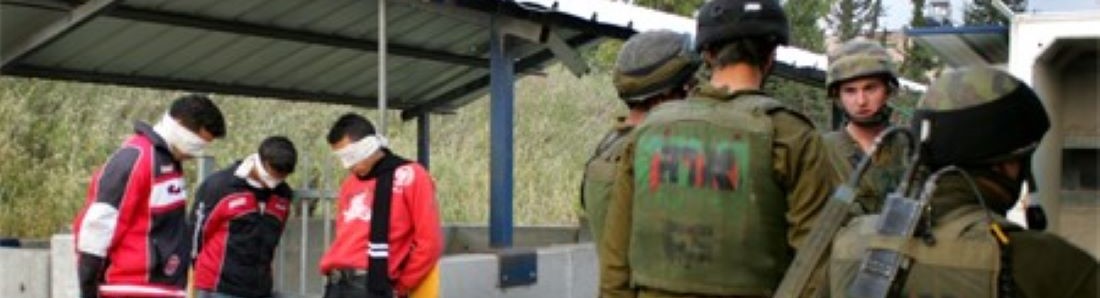
“Beit Iba Checkpoint, West Bank” by Kashkilck. Licensed under CC BY-NC 2.0
About Thinking Out Loud
Thinking Out Loud is a commentary series by Lara Kajs examining international law, humanitarian crises, and the prevention of mass atrocities. Drawing on field experience in conflict and displacement settings, the column explores the legal and policy challenges that shape contemporary conflicts.
About the Author
Lara Kajs is the founder and executive director of The Genocide Report, a Washington, DC-based educational nonprofit focused on atrocity prevention and international law. She is the author of several field-based books on conflict, displacement, humanitarian crises, and international humanitarian law, drawing on extensive research and field experience in Yemen, Syria, and Afghanistan. Her writing and public speaking focus on atrocity crimes, forced displacement, the protection of civilians, and the legal frameworks governing armed conflict.