By Lara Kajs
Thinking Out Loud
This piece examines the rapid erosion of rights for women and girls in Afghanistan following the Taliban’s return to power in 2021. It explores how a series of restrictive decrees has limited access to education, employment, healthcare, and freedom of movement, and considers the broader implications for human rights, economic stability, and international engagement. The piece also reflects on the concept of “gender apartheid” and the long-term consequences of systematically excluding half the population from public life.
The return of the Taliban to power in Afghanistan in August 2021 raised immediate concerns about the future of women and girls. Over the past two decades, significant—if uneven—progress has been made in expanding access to education, employment, and public life. Within months of the Taliban’s return, many of those gains were reversed.
What followed was not unexpected, but its speed and scope remain striking.
Systematic Restrictions
Since late 2021, the Taliban has issued a series of decrees restricting the rights and freedoms of women and girls. These measures include limitations on movement, employment, education, and access to healthcare.
Women are prohibited from traveling long distances without a male guardian, and transport providers risk penalties for carrying women who do not comply with dress requirements. These restrictions have had immediate and practical consequences, including reduced access to employment, medical care, and essential services.
Households headed by women have been particularly affected. With restrictions on female employment, many families have lost their primary source of income, contributing to rising levels of food insecurity. According to the World Food Programme, food insecurity has reached critical levels across the country, disproportionately affecting female-headed households.
Economic and Social Impact
The cumulative effect of these policies extends beyond individual restrictions. They reshape the structure of Afghan society by limiting women’s participation in public and economic life.
In the healthcare sector, restrictions on interactions between male providers and female patients have reduced access to care, particularly in areas where female healthcare professionals are limited. In education, the closure of secondary schools for girls has interrupted learning for an entire generation.
These conditions have also contributed to secondary harms. Humanitarian organizations have reported increases in early and forced marriages, as families facing extreme economic hardship seek ways to cope.
The exclusion of women from public life reshapes not only individual futures, but the trajectory of an entire country.”
Legal and Conceptual Framing
Some observers and legal scholars have characterized these developments as “gender apartheid,” a term used to describe systematic and institutionalized discrimination based on gender.
While not formally codified as an international crime in the same way as apartheid based on race, the concept highlights the scale and structure of exclusion imposed on women and girls. The policies enacted by the Taliban create a system in which rights, mobility, and access to opportunity are determined by gender.
Education and the Loss of Opportunity
Early Taliban statements suggested that girls’ education would continue under certain conditions. However, in March 2022, girls’ secondary schools were closed, contradicting prior assurances.
The long-term implications are significant. Education is closely linked to economic participation, health outcomes, and social stability. The exclusion of girls from education not only limits individual opportunity but also affects broader development outcomes for the country.
International Response
The international community has consistently raised concerns about the treatment of women and girls in Afghanistan. António Guterres stated that “no country can thrive while denying the rights of half its population,” urging the Taliban to reconsider its policies.
Despite diplomatic engagement and public pressure, there has been limited change in Taliban policy. Recognition of the Taliban government remains a point of leverage, but it has not yet produced measurable improvements in conditions for women and girls.
A Reversal of Progress
The developments in Afghanistan represent a rapid and comprehensive rollback of rights that had expanded over the previous two decades. While the trajectory was widely anticipated, the international response has struggled to match the urgency of the situation.
The question is no longer whether these restrictions will persist, but how the international community will respond to a system that systematically excludes half the population from public life.
Published 6 September 2022
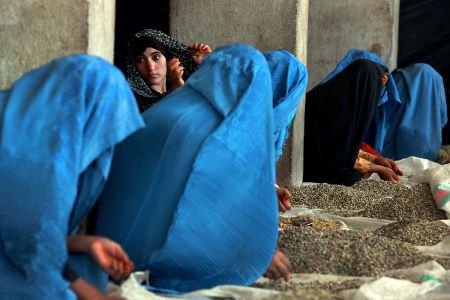
Photo Credit: United Nations Photo – Women on the Job in Afghanistan
About Thinking Out Loud
Thinking Out Loud is a commentary series by Lara Kajs examining international law, humanitarian crises, and the prevention of mass atrocities. Drawing on field experience in conflict and displacement settings, the column explores the legal and policy challenges that shape contemporary conflicts
About the Author
Lara Kajs is the founder and executive director of The Genocide Report, a Washington, DC-based educational nonprofit focused on atrocity prevention and international law. She is the author of several field-based books on conflict, displacement, humanitarian crises, and international humanitarian law, drawing on extensive research and field experience in Yemen, Syria, and Afghanistan. Her writing and public speaking focus on atrocity crimes, forced displacement, the protection of civilians, and the legal frameworks governing armed conflict.