
By Lara Kajs
Thinking Out Loud
This piece explores Russia’s long-standing strategy of territorial expansion under Vladimir Putin, including invasions of Georgia and Ukraine, and the implications for international law, sovereignty, and civilian safety. It highlights how these unprovoked land grabs challenge the rules-based global order, place civilians at risk, and underscore the importance of accountability, international support for Ukraine, and the defense of nations facing coercion.
Russia already possesses more land mass than any other country on Earth, accounting for roughly eleven percent of the world’s territory. Yet despite this, territorial expansion has remained a consistent feature of its foreign policy. Through a series of unprovoked invasions and annexations, Russia has seized land from sovereign states in clear violation of international law.
Russia’s Imperial Ambition
For more than two decades, Vladimir Putin has pursued a vision of restoring Russia’s status as a global power. Central to that vision is reasserting influence over post-Soviet states, countering the expansion of NATO, and leveraging Russia’s position on the United Nations Security Council to shape international outcomes in its favor.
This strategy has repeatedly manifested in territorial aggression.
In 2008, Russia invaded Georgia, occupying and subsequently recognizing the regions of Abkhazia and South Ossetia as independent—effectively annexing them. Georgian authorities and international observers characterized the resulting displacement of civilians as ethnic cleansing.
In 2014, Russia escalated further by invading and annexing Ukraine’s Crimean Peninsula. Russian officials justified the action as necessary to protect civilians and safeguard military infrastructure, but the move was widely condemned as a violation of sovereignty and international law.
A Pattern of Territorial Expansion
These actions are not isolated events. They reflect a consistent pattern.
The simplest explanation is often the most accurate: Russia is expanding its territory. Rebuilding influence over former Soviet space requires land, population, and resources—objectives that cannot be achieved without altering borders.
The full-scale invasion of Ukraine is the clearest expression of this strategy. Since 2022, Russia has claimed the annexation of four Ukrainian regions—Donetsk, Luhansk, Kherson, and Zaporizhzhia—amounting to nearly fifteen percent of Ukraine’s territory. These claims, made under conditions of military occupation, lack legal validity under international law.
International leaders have been unequivocal. António Guterres stated that such annexations “have no legal value.” Antony Blinken described them as a “futile attempt at a land grab,” while Joe Biden emphasized that the war challenges Ukraine’s very right to exist as a state.
Ukraine’s Resistance
Ukraine, however, has not yielded.
Under the leadership of Volodymyr Zelensky, the country has mounted a sustained defense against Russian aggression. In December 2022, Zelensky addressed the U.S. Congress, framing international support not as charity, but as an investment in global security and democratic stability.
His message underscored a broader reality: Ukraine’s fight is not only about territorial integrity, but about resisting coercion and preserving sovereignty in the face of force.
Ukraine’s fight is not only for territory, but for the principle that borders cannot be redrawn by force.”
The Cost of Inaction
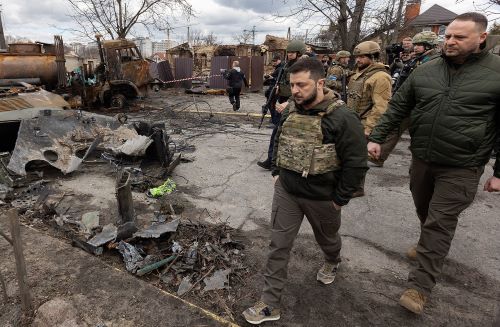
The consequences of this conflict are visible in the widespread destruction of civilian infrastructure—homes, hospitals, schools, and public spaces—resulting in significant civilian casualties and displacement.
The stakes extend beyond Ukraine. If territorial conquest through force is left unchecked, it erodes the foundation of the international legal order. Sovereignty, territorial integrity, and the prohibition on the use of force are not abstract principles; they are essential to global stability.
The question, then, is not only how this conflict ends, but what precedent it sets.
If violations of international law are met with limited resistance, the risk is not contained to one region. It becomes a global concern.
Published 22 December 2022
Photo Credit: Bucha after Russian Invasion of Ukraine, President Zelensky and Yermak by Oleksandr Ratushniak. Licensed under CC by SA 4.0
About Thinking Out Loud
Thinking Out Loud is a commentary series by Lara Kajs examining international law, humanitarian crises, and the prevention of mass atrocities. Drawing on field experience in conflict and displacement settings, the column explores the legal and policy challenges that shape contemporary conflicts
About the Author
Lara Kajs is the founder and executive director of The Genocide Report, a Washington, DC-based educational nonprofit focused on atrocity prevention and international law. She is the author of several field-based books on conflict, displacement, humanitarian crises, and international humanitarian law, drawing on extensive research and field experience in Yemen, Syria, and Afghanistan. Her writing and public speaking focus on atrocity crimes, forced displacement, the protection of civilians, and the legal frameworks governing armed conflict.