
Lara Kajs
Thinking Out Loud
Civilian protection frameworks are designed to limit harm to civilians during armed conflict, particularly in densely populated environments. In Gaza, however, the scale of destruction and displacement has intensified scrutiny of whether those protections function effectively in practice. As recovery operations continue across destroyed neighborhoods, the discussion is shifting from legal theory toward the visible consequences left behind by sustained warfare.
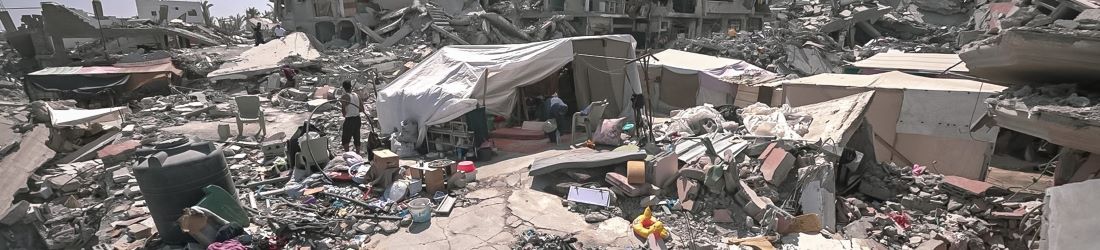
As debris is cleared across parts of the Gaza Strip, recovery efforts are revealing what lies hidden beneath collapsed structures: human remains, still clothed, preserved in the positions in which they died. These are not abstract indicators of civilian harm. They are physical evidence of lives interrupted and protection that did not hold.
The language of armed conflict often operates at a distance—through casualty figures, strike assessments, and legal standards. But recovery shifts that distance. It replaces abstraction with proximity. What is uncovered beneath the rubble is not only loss. It is evidence.
The Evidence Beneath the Rubble
In the aftermath of sustained hostilities, the process of clearing debris becomes an act of discovery. Beneath collapsed buildings, responders are finding individuals where they sought shelter, where they lived, and where they could not escape. The presence of remains within homes, under structural collapse, reflects the conditions under which civilians experienced the conflict.
It has been more than a year since one of the deadliest strikes destroyed a five-story apartment building in Beit Lahia in 2024. In the period that followed, continued bombardment reduced much of the surrounding area to rubble. What was once a densely populated residential neighborhood was effectively erased. Beneath the ruins, large numbers of bodies are still believed to remain.
According to the International Committee of the Red Cross, recovery capacity is severely limited. At times, only a single functioning excavator has been available for body recovery operations. While some bodies have been recovered, many remain inaccessible beneath collapsed structures. Rescue workers report that those recovered are often skeletons, still clothed, preserved in the positions in which they died.
Identification presents additional challenges. There is no operational DNA testing capacity within Gaza. In many cases, identification relies on clothing and personal effects rather than forensic confirmation.
Recovery itself is not purely technical—it is constrained by the broader conflict environment. Delays in access, limitations on equipment, and ongoing insecurity have slowed efforts to locate and recover the dead. In places like Beit Lahia, families continue to wait for the opportunity to find and bury relatives.
The scale of loss remains difficult to quantify. Figures reported by the Gaza Ministry of Health exceed 75,000 deaths. However, these figures do not fully account for those still buried beneath debris, those never formally recorded, or those buried outside formal systems. The true number is likely significantly higher.
These findings are not isolated. They form patterns of structural collapse, of civilian presence at the point of impact, and of limited capacity to recover and document the full extent of harm. The details matter not only for their immediacy, but for what they indicate. They provide a record of how and where civilians were situated at the time of the attack.
This is not simply recovery. It is the reconstruction of events through physical evidence.
What Civilian Protection Is Intended to Prevent
International humanitarian law establishes clear principles intended to limit the effects of armed conflict on civilian populations. Civilians are not to be targeted. Civilian harm must not be excessive in relation to anticipated military advantage. Precautions must be taken to minimize risk. These principles exist not only to regulate conduct but to prevent outcomes like those now being uncovered.
Even where civilian protection mechanisms function as intended, the expectation is not the absence of all harm, but the reduction of its likelihood and severity. The presence of widespread structural collapse containing civilians raises questions not only about individual incidents, but about whether these protective mechanisms operated effectively at scale.
“What is uncovered beneath the rubble is not only loss—it is evidence of protection that failed.”
When Protection Fails in Practice
The conditions in Gaza complicate the application of these frameworks. High population density, limited evacuation options, and the proximity of military activity to civilian environments create a context in which civilians are consistently exposed to risk. For many civilians in Gaza, evacuation did not mean escape from conflict. It meant repeated displacement within an enclosed war zone.
Hamas operates within this environment as both a governing authority and an armed actor, while Israeli military operations are directed toward degrading those capabilities. Civilians live within the space where these dynamics intersect.
As of May 2026, Gaza remains under a ceasefire (in name only) that began in late 2025, yet conditions on the ground continue to reflect sustained instability. Ongoing strikes, territorial control, and intermittent hostilities have led some observers to describe the situation not as post-conflict, but as a form of limited, continuing war. While Israel agreed to allow 600 humanitarian trucks into Gaza each day, they are only admitting 250 trucks per day.
For the approximately 2.1 million residents of Gaza, this translates into prolonged exposure to insecurity, severe shortages of essential goods, and widespread destruction of infrastructure, including homes and medical facilities. Humanitarian efforts led by the United Nations and other actors continue under constrained conditions, attempting to stabilize a situation that remains highly volatile.
But complexity does not negate outcome. It does not alter the fact that civilians remained in place, that structures collapsed around them, and that many did not have the capacity to avoid exposure. When recovery reveals patterns of death within civilian spaces, the question is no longer whether risk existed. It is how that risk was managed, and whether it was sufficiently mitigated.
The Gap Between Law and Outcome
Legal frameworks are evaluated not only by their articulation, but by their outcomes. In Gaza, the gap between those two points is visible. The law defines obligations. It establishes limits. But it does not enforce itself. Its effectiveness depends on application, interpretation, and consequence.
When civilian remains are recovered in the locations where they lived, slept, and sought safety, the outcome stands in contrast to the intended functions of those protections. This does not resolve questions of legality in any individual case. It does, however, raise broader concerns about consistency, proportionality assessments, and the adequacy of precautionary measures across repeated operations.
The issue is not whether the law exists. It is whether it has functioned in a way that meaningfully altered outcomes.
Evidence and Accountability
The remains uncovered in Gaza are not only the result of past events. They are also evidence.
The location of bodies, the condition of structures, and the patterns of destruction contribute to a factual record that may inform future investigations. Documentation collected during recovery—whether by local responders, humanitarian organizations, or independent investigators—plays a role in establishing what occurred. In this sense, recovery is not only humanitarian. It is evidentiary.
Accountability processes rely on such evidence to assess compliance with international law. Without it, claims remain contested and difficult to substantiate. With it, patterns can be examined, responsibilities evaluated, and legal determinations pursued. But evidence alone does not ensure accountability. It must be recognized, preserved, and acted upon.
The Risk of Normalization
One of the most significant risks in prolonged conflict is the normalization of outcomes that would otherwise be understood as failures. When large-scale destruction of civilian structures becomes routine, when recovery efforts consistently uncover civilian remains, and when these patterns do not result in sustained consequence, the threshold for what is considered acceptable begins to shift.
This normalization does not occur through explicit endorsement. It occurs through repetition without interruption.
Over time, the distinction between exceptional harm and expected outcome becomes less clear. Civilian protection, rather than functioning as a constraint, becomes conditionally dependent on circumstances that are not consistently enforced.
The Bottom Line: Protection Measured by Outcome
The situation in Gaza does not require a reinterpretation of legal principles to understand what has occurred. The principles are clear. The question is whether they have achieved their intended purpose.
Civilian protection is not measured by the existence of legal frameworks. It is measured by the outcomes that those frameworks are designed to prevent. What is being uncovered beneath the rubble provides one form of answer. It is not abstract. It is not theoretical. It is physical, documented, and increasingly difficult to ignore.
Published: 7 May 2026
Photo Credit
Gaza war 2023-2025 IMG 8181 by Jaber Jehad Badwin. Licensed under CC BY-SA 4.0
About Thinking Out Loud
Thinking Out Loud is a commentary series by Lara Kajs examining international law, humanitarian crises, and the prevention of mass atrocities. Drawing on field experience in conflict and displacement settings, the column explores the legal and policy challenges that shape contemporary conflicts.
About the Author
Lara Kajs is the founder and executive director of The Genocide Report, a Washington, DC-based educational nonprofit focused on atrocity prevention and international law. She is the author of several field-based books on conflict, displacement, humanitarian crises, and international humanitarian law, drawing on extensive research and field experience in Yemen, Syria, and Afghanistan. Her writing and public speaking focus on atrocity crimes, forced displacement, the protection of civilians, and the legal frameworks governing armed conflict.