Lara Kajs
Thinking Out Loud
When “Terrorist” Groups Govern: Why the World Misunderstands Power in Conflict Zones
Armed non-state actors are often framed narrowly within international discourse as security threats, insurgent groups, or terrorist organizations. While these designations are not inaccurate, they are incomplete. In several regions—particularly across the Middle East—such actors do not operate solely outside the state. They function within it. They govern territory, provide services, exert political influence, and shape the daily lives of civilian populations. The distinction between “armed group” and “governing authority” is not academic—it has direct consequences for how the world responds to crises.
Labels make complex realities easier to process, easier to communicate, and easier to categorize within policy frameworks. But they also obscure. This dual role complicates both analysis and policy response. Groups such as Hezbollah in Lebanon, Hamas in Gaza, and the Houthis in Yemen are not only participants in conflict; they are embedded within systems of governance. They exercise authority over populations while simultaneously engaging in armed hostilities. This convergence of political power and military capability produces environments in which accountability mechanisms are weakened or entirely absent.
The result is not simply instability. It is the normalization of governance structures in which civilians are subject to overlapping systems of control, often without access to protection under domestic or international law. When governance realities are ignored, civilian needs are misread, humanitarian strategies weaken, and accountability frameworks erode.
Hybrid Authority and the Erosion of the State
Traditional governance models assume a clear distinction between state authority and non-state actors. It is easier to engage with conflict when actors can be clearly defined as legitimate or illegitimate, state or non-state, ally or adversary. In practice, this distinction has eroded in multiple conflict-affected environments. Armed groups increasingly operate as hybrid authorities—simultaneously political actors, military forces, and service providers.
Hybrid actors disrupt clarity and force difficult questions, such as: Can an actor be both a governing authority and a violator of international law? What does accountability look like in that context? How should the international community engage without legitimizing harmful conduct? These are not easy questions, and there are no clean answers. Avoiding them does not resolve the tension—it simply obscures the reality of modern conflict.
In Lebanon, Hezbollah maintains significant political representation while also operating an independent military structure. In Gaza, Hamas functions as the governing authority, administering civil institutions while continuing to engage in armed conflict. In Yemen, the Houthis exercise territorial control over large population centers, shaping governance outcomes in areas under their influence.
These arrangements create layered systems of authority in which the state does not fully monopolize the use of force. Instead, power is distributed across actors with differing legal obligations and varying degrees of international recognition. For civilians, this often translates into uncertainty regarding rights, protections, and recourse.
The erosion of centralized authority also complicates external engagement. Diplomatic efforts, humanitarian operations, and accountability mechanisms must navigate fragmented systems in which responsibility is diffuse, and enforcement capacity is limited.
Civilian Populations in Contested Governance Spaces
Where governance is shared, fragmented, or contested, civilian populations frequently bear the consequences. The presence of armed actors within civilian environments increases exposure to violence, particularly in contexts where military objectives are pursued in densely populated areas.
At the same time, the integration of these groups into governance structures creates additional layers of vulnerability. Civilians do not experience these actors as abstract categories. They experience them as authorities—often the only authorities present. Civilians may depend on these actors for essential services while simultaneously being subjected to coercion, surveillance, or forced participation in conflict-related activities.
In such environments, the distinction between civilian and combatant space becomes increasingly blurred. This has direct implications for protection. Civilian risk is driven not only by active hostilities but by the structural conditions created by hybrid governance itself.
These dynamics are further compounded by restrictions on movement, limitations on humanitarian access, and the politicization of aid. Civilian populations often find themselves navigating systems in which basic needs are mediated through actors who are also parties to the conflict.
We cannot understand modern conflict if we refuse to acknowledge who actually governs the people caught inside it.”
International Designations and Policy Constraints
The designation of armed groups as terrorist organizations by states and international bodies plays a significant role in shaping policy responses. While such designations are grounded in security concerns, they also introduce constraints on engagement.
Humanitarian organizations, for example, may face legal and operational barriers when attempting to deliver assistance in areas controlled by designated groups. Diplomatic channels may be limited or entirely absent, reducing opportunities for negotiation, de-escalation, or civilian protection measures.
This creates a persistent tension within international policy frameworks. On one hand, there is a clear imperative to address security threats and uphold legal norms. On the other hand, there is a need to engage with de facto authorities to reach civilian populations and mitigate harm.
The result is often an inconsistent approach in which engagement occurs indirectly, selectively, or not at all. In practical terms, this can delay aid delivery, complicate conflict resolution efforts, and reduce the effectiveness of protection strategies.
External Support and Regional Dynamics
The influence of external actors further complicates the landscape. Armed groups operating within these hybrid governance structures are frequently supported—politically, financially, or militarily—by external states. Iran has been widely identified as providing support to actors such as Hezbollah, Hamas, and the Houthis, while Russia has, in certain contexts, engaged with or supported aligned actors across the region. At the same time, sustained military operations by Israel in Lebanon, Gaza, and Yemen further shape the operational environment in which these groups function. These overlapping external influences reinforce existing power structures and prolong conflict dynamics, while intensifying risks for civilian populations. It may also limit the willingness of international actors to pursue accountability, particularly where geopolitical alliances are involved.
Regional competition, strategic interests, and proxy dynamics intersect in ways that shape both the trajectory of conflict and the scope of international response. Civilian protection, in this context, is often secondary to broader geopolitical considerations.
The involvement of external actors also raises complex legal questions, particularly in relation to state responsibility and the provision of support to parties engaging in violations of international law.
The Accountability Gap
One of the most significant consequences of hybrid governance is the emergence of an accountability gap. When armed actors operate within state structures but are not fully subject to state control, traditional mechanisms for accountability become difficult to apply.
Domestic legal systems may lack the capacity or willingness to prosecute violations. International mechanisms, while available in principle, often face political and jurisdictional limitations. In the absence of effective enforcement, patterns of abuse can persist.
This gap is not merely a legal issue—it is a structural condition that shapes behavior. Where accountability is unlikely, the deterrent effect of international law is diminished. This has direct implications for civilian protection and the prevention of further atrocities.
The Bottom Line: Rethinking Governance and Protection
Understanding the modern conflict environment requires moving beyond binary distinctions between state and non-state actors. In regions where armed groups function as governing authorities, the reality is more complex.
Policy responses must account for this complexity. This includes reassessing how engagement occurs, how legal frameworks are applied, and how protection strategies are designed in contexts of fragmented authority.
The presence of hybrid governance structures does not negate the applicability of international law. If anything, it underscores the need for more consistent application and enforcement. Civilian populations living under these conditions are not outside the scope of protection; they are among those most in need of it.
Understanding does not mean endorsement. Recognizing governance does not legitimize conduct. It simply reflects an accurate assessment of the environment in which civilians live. If the goal is to reduce harm, improve protection, and strengthen accountability, then analysis must begin with reality—not with the categories we prefer.
As conflicts in Lebanon, Gaza, and Yemen continue to evolve, the role of proxy actors within governance structures will remain central to both the risks faced by civilians and the possibilities for meaningful response.
If we want to respond effectively, we have to be willing to see that complexity clearly. Because those living under these systems do not have the luxury of simplification.
Published: 30 April 2026
Photo Credit
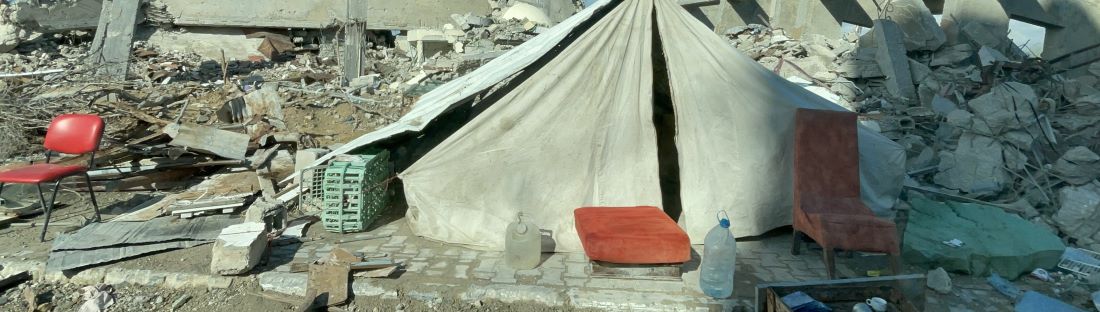
A tent set up by the homeowner among the rubble of his house after an Israeli airstrike in the Gaza war, by Jaberr Bedwan. Licensed under CC BY-SA 4.0
About Thinking Out Loud
Thinking Out Loud is a commentary series by Lara Kajs examining international law, humanitarian crises, and the prevention of mass atrocities. Drawing on field experience in conflict and displacement settings, the column explores the legal and policy challenges that shape contemporary conflicts.
About the Author
Lara Kajs is the founder and executive director of The Genocide Report, a Washington, DC-based educational nonprofit focused on atrocity prevention and international law. She is the author of several field-based books on conflict, displacement, humanitarian crises, and international humanitarian law, drawing on extensive research and field experience in Yemen, Syria, and Afghanistan. Her writing and public speaking focus on atrocity crimes, forced displacement, the protection of civilians, and the legal frameworks governing armed conflict.