By Lara Kajs
Thinking Out Loud
This analysis examines Yemen’s ongoing “no war, no peace” status, exploring the roots of the conflict, stalled diplomatic efforts, and the deepening humanitarian crisis amid limited international follow-through.
Yemen exists in a state of neither war nor peace. While the reduction in large-scale hostilities is preferable to active conflict, an “unofficial” ceasefire is inherently unstable. Diplomatic efforts to end the war—now entering its ninth year—have yet to produce a durable political settlement. In the absence of such an agreement, economic collapse and humanitarian suffering continue to deepen.
A Protracted Conflict
Yemen’s current crisis emerged from the broader wave of uprisings during the Arab Spring. In Yemen, protests led to the resignation of President Ali Abdullah Saleh and the transfer of power to Vice President Abdrabbuh Mansur Hadi.
Political transition, however, failed to deliver stability. Public discontent persisted, governance weakened, and competing factions expanded their influence. The Houthi movement consolidated control in the north, ultimately seizing the capital, Sana’a, in 2014. President Hadi fled to Saudi Arabia, prompting a regional response.
In 2015, a Saudi-led coalition—supported by the United States, the United Kingdom, France, and regional partners—launched a military campaign aimed at restoring the internationally recognized government. The conflict quickly escalated into a protracted war marked by widespread destruction and civilian harm.
All parties to the conflict have been accused of violations of international humanitarian law, including attacks on civilian infrastructure, arbitrary detention, and enforced disappearances.
Fragmentation and External Influence
Yemen’s conflict is no longer defined by two sides. It is a fragmented landscape of competing actors, each pursuing local or regional objectives.
Iran’s relationship with the Houthis remains a focal point of international debate. While Tehran has provided varying degrees of political and material support, characterizing the Houthis as a proxy force oversimplifies a more complex reality. The group has demonstrated independent decision-making and draws significant resources from local networks and informal arms markets.
Stalled Pathways to Peace
Diplomatic efforts have produced limited and uneven progress. The 2018 Stockholm Agreement helped prevent a major escalation in the port city of Hodeidah, but key provisions were never fully implemented.
In 2022, President Hadi transferred authority to a presidential leadership council in an effort to unify anti-Houthi factions and re-energize negotiations. A UN-brokered ceasefire later that year led to a temporary reduction in violence, but its expiration without renewal cemented the current condition: no war, no peace.
The exclusion of key domestic actors from certain negotiation tracks has further complicated prospects for a sustainable settlement. As seen in other conflicts, agreements that lack inclusive political representation often struggle to endure.
Humanitarian Crisis
Yemen remains one of the world’s most severe humanitarian crises.
After years of conflict, economic isolation, and disrupted supply chains, basic goods have become unaffordable for much of the population. Restrictions on imports and damage to infrastructure have significantly limited access to food, fuel, and medical supplies.
According to UN estimates, hundreds of thousands of people have died as a result of the conflict, with a majority of deaths attributed to indirect causes such as hunger, lack of clean water, and limited healthcare access. Tens of millions remain in need of assistance, with widespread food insecurity and malnutrition affecting large segments of the population.
Public health conditions continue to deteriorate. Outbreaks of preventable diseases—including cholera and measles—have spread rapidly in the absence of functioning health systems. Millions lack access to safe water and sanitation services.
Displacement remains widespread, with more than four million Yemenis forced from their homes, often multiple times. Despite these conditions, Yemen continues to host refugees from the Horn of Africa, adding further strain to already limited resources.
Aid and Resource Constraints
Humanitarian operations in Yemen are increasingly constrained by funding shortfalls. International pledges have not consistently translated into delivered resources, forcing aid organizations to reduce food assistance, healthcare support, and essential services.
This gap between commitments and delivery has tangible consequences. Reduced funding translates directly into fewer rations, limited medical care, and diminished capacity to respond to outbreaks and emergencies.
Field Perspective
Between 2018 and 2021, my team and I spent extended periods on the ground in Yemen documenting human rights conditions and humanitarian needs.
What emerges from that experience is not only the scale of suffering, but the persistence of resilience. Yemeni civilians continue to navigate a crisis they did not create and cannot control. Their expectations are not abstract—they are immediate: access to food, safety, and the possibility of stability.
The Bottom Line
Yemen’s current condition is not a resolution—it is a pause without guarantees. Without a comprehensive political settlement, the factors that drove the conflict remain in place.
Sustainable peace will require more than ceasefires. It will depend on inclusive governance, economic stabilization, and sustained international engagement. Until then, Yemen will remain suspended between conflict and recovery—neither at war, nor at peace.
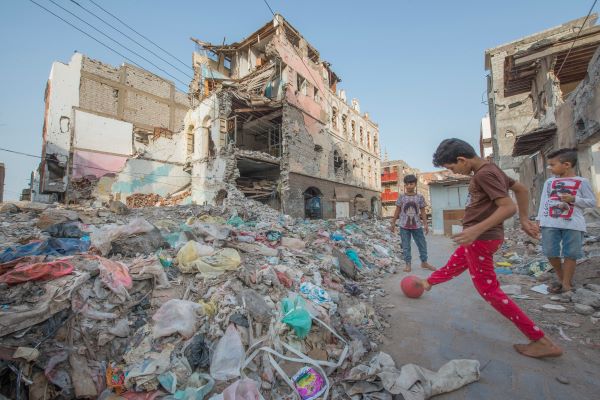
Photo Credit: “Yemen: responding to the world’s largest humanitarian crisis” by EU Civil Protection and Humanitarian Aid. Licensed under CC by NC ND 2.0
Published 21 September 2023
About Thinking Out Loud
Thinking Out Loud is a commentary series by Lara Kajs examining international law, humanitarian crises, and the prevention of mass atrocities. Drawing on field experience in conflict and displacement settings, the column explores the legal and policy challenges that shape contemporary conflicts
Lara Kajs is the founder and executive director of The Genocide Report, a Washington, DC-based educational nonprofit focused on atrocity prevention and international law. She is the author of several field-based books on conflict, displacement, humanitarian crises, and international humanitarian law, drawing on extensive research and field experience in Yemen, Syria, and Afghanistan. Her writing and public speaking focus on atrocity crimes, forced displacement, the protection of civilians, and the legal frameworks governing armed conflict.