By Lara Kajs
Thinking Out Loud
This piece analyzes the one-year aftermath of Mahsa Amini’s death, examining state repression, lack of accountability, and the evolution of Iran’s Woman, Life, Freedom movement.
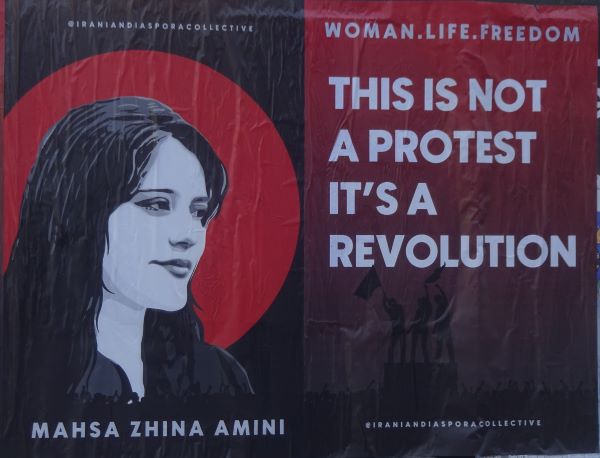
One year ago, 22-year-old Mahsa Amini was detained by Iran’s morality police for allegedly violating mandatory hijab laws. Witnesses reported that she was beaten while in custody. She fell into a coma and died four days later.
Her death sparked the largest wave of protests in Iran since the Iranian Revolution. Within days, demonstrations spread across the country, unified by a single slogan: Woman, Life, Freedom. What began as outrage over one death evolved into a broader movement challenging systemic repression—and it continues to resonate both within Iran and globally.
In the months that followed, acts of resistance took many forms. Nightly chants echoed from rooftops across all 31 provinces, signaling both defiance and solidarity. Under mounting pressure, authorities announced a suspension of the morality police, framing it as a restructuring effort. However, this pause proved temporary.
No Accountability
In the year since Amini’s death, there has been no meaningful accountability for the killing of protesters. No officials have been criminally investigated or prosecuted for actions taken during the crackdown.
According to Iran Human Rights, more than 500 protesters were killed, including dozens of women and children. Authorities have attributed some deaths to “suicide” or natural causes—claims that have been widely disputed. In Amini’s case, official assertions of heart failure were contradicted by evidence of physical trauma.
Security forces employed live ammunition, metal pellets, and mass arrests to suppress demonstrations. Reports document widespread human rights violations, including torture, sexual violence in detention, and reprisals against victims’ families.
The scale and severity of abuses prompted the United Nations to establish an independent fact-finding mission to investigate potential violations of international law.
One Year Later
By the first anniversary of Amini’s death, visible street protests had largely subsided under intensified state control. A significant security presence across major cities has deterred large-scale demonstrations.
At the same time, enforcement mechanisms have evolved. The morality police were reinstated, but with modified tactics. Rather than physical detention, authorities increasingly rely on surveillance, fines, and administrative penalties.
New measures include the use of traffic cameras to identify unveiled women, financial penalties that escalate with repeated violations, and restrictions on access to services, including travel, banking, internet usage, and, in some cases, healthcare.
Institutional Control & Structural Inequality
The state has also expanded control over academic institutions. Hundreds of university professors were dismissed following expressions of support for protesters. Students and faculty have been required to sign declarations agreeing not to engage in political speech as a condition of participation in academic life. These measures reflect a broader effort to consolidate control over key centers of dissent.
Under Iran’s legal framework, women face systemic restrictions across multiple domains, including dress, family law, and civic participation. Mandatory veiling laws remain central to state enforcement of social control.
Proposed legislation, including the Hijab and Chastity Bill, signals the possibility of even stricter penalties, including harsher punishments for violations. Observers have raised concerns about the long-term trajectory of women’s rights under these measures.
A Movement Transformed
Although mass protests have diminished, the underlying grievances have not. What began as a response to one woman’s death has expanded into a broader challenge to governance, economic conditions, and social restrictions.
Forms of resistance have adapted. Many women now choose not to wear the hijab in public—an act of quiet defiance that carries significant personal risk.
The Woman, Life, Freedom movement has not ended; it has evolved. Its visibility may fluctuate, but its impact endures—in shifting public attitudes, in ongoing acts of resistance, and in the global attention it continues to command.
Photo credit: “22-11-26 04 Mahsa Amini Poster” by Felton Davis. Licensed under CC by 2.0
Published 16 September 2023
About Thinking Out Loud
Thinking Out Loud is a commentary series by Lara Kajs examining international law, humanitarian crises, and the prevention of mass atrocities. Drawing on field experience in conflict and displacement settings, the column explores the legal and policy challenges that shape contemporary conflicts
Lara Kajs is the founder and executive director of The Genocide Report, a Washington, DC-based educational nonprofit focused on atrocity prevention and international law. She is the author of several field-based books on conflict, displacement, humanitarian crises, and international humanitarian law, drawing on extensive research and field experience in Yemen, Syria, and Afghanistan. Her writing and public speaking focus on atrocity crimes, forced displacement, the protection of civilians, and the legal frameworks governing armed conflict.