
By Lara Kajs
Thinking Out Loud
This article reflects on the 1994 genocide against the Tutsi in Rwanda, examining early warning signs, international inaction, and the ongoing challenges of atrocity prevention and accountability.
Each year on 7 April, Rwanda begins 100 days of remembrance known as Kwibuka, honoring the victims of the 1994 genocide against the Tutsi.
Over the course of approximately three months, an estimated 800,000 to one million people were killed in one of the most concentrated episodes of mass violence in modern history. The majority of victims were Tutsis, targeted systematically by state forces, militias, and civilians.
Thirty years later, Kwibuka serves not only as a period of mourning but as a reminder of the consequences of inaction in the face of clear warning signs.
Warning Signs Ignored
The genocide in Rwanda did not occur without warning.
In the years leading up to April 1994, extremist rhetoric and propaganda increasingly called for the elimination of the Tutsi population. Media outlets, including radio broadcasts, played a central role in inciting violence, while lists of targeted individuals were compiled and distributed.
At the same time, large quantities of machetes were imported into the country—tools that would later become synonymous with the killings.
By 1993, the situation had escalated to the point that UN Special Rapporteur Bacre Waly Ndiaye warned that the conditions for genocide were present and that the Genocide Convention could be invoked.
These warnings were not acted upon.
From an atrocity prevention perspective, Rwanda represents a case in which multiple early warning indicators were clearly visible, yet failed to trigger meaningful international intervention.
Rwanda represents a case in which early warning signs were clearly visible—yet failed to trigger meaningful international action.”
The Onset of Genocide
The immediate catalyst came on 6 April 1994, when a plane carrying Rwandan President Juvénal Habyarimana and Burundian President Cyprien Ntaryamira was shot down near Kigali. Within hours, roadblocks were established, and coordinated killings began.
On 7 April, soldiers and militia groups initiated systematic campaigns targeting Tutsis and moderate Hutus. The violence was organized, rapid, and public.
Prime Minister Agathe Uwilingiyimana was among the first high-profile victims. She was killed along with ten Belgian UN peacekeepers assigned to protect her—an act that contributed to Belgium’s decision to withdraw its forces.
Across the country, civilians were identified through identity cards, dragged from homes, and killed—often by neighbors or local militias. Sexual violence, torture, and public fear became widespread. In many cases, massacres occurred in places where civilians had sought refuge, including churches.
International Inaction
Despite the scale and speed of the killings, the international response was limited and delayed.
The United Nations Assistance Mission for Rwanda (UNAMIR) operated under a restricted mandate that prevented peacekeepers from intervening to stop the violence. As a result, forces on the ground were largely unable to protect civilians.
The withdrawal of international forces further weakened the response at a critical moment.
In the aftermath, former UN Secretary-General Kofi Annan acknowledged the failure of the international community, stating that Rwanda would remain a source of “bitter regret and abiding sorrow.”
Rwanda has since become a defining case study in the failure of the international system to prevent genocide—even when warning signs are present and recognized.
Justice and Recovery
In the decades since 1994, Rwanda has undertaken a complex process of recovery and accountability.
International and domestic mechanisms, including the International Criminal Tribunal for Rwanda (ICTR) and local gacaca courts, have prosecuted thousands of individuals responsible for genocide-related crimes. However, accountability remains incomplete. Some perpetrators continue to evade justice, and mass graves are still being discovered.
Rwanda’s post-genocide reconstruction has been significant, with notable progress in stability and economic development. At the same time, the country’s political trajectory—under President Paul Kagame—has drawn both praise for reconstruction efforts and criticism for restrictions on political freedoms.
The Language of Genocide
One of the enduring questions raised by Rwanda is why the term “genocide” is so often avoided in real time.
The legal definition exists. The indicators are well documented. Yet, political hesitation frequently delays recognition, which in turn delays action. This reluctance has consequences.
Rwanda demonstrates that the failure to name atrocities accurately can contribute to the failure to prevent them. The distinction between recognizing risk and acting on it remains one of the central challenges in atrocity prevention.
Beyond “Never Again”
The phrase “Never Again” emerged from the aftermath of the Holocaust and has since become a guiding principle in discussions of mass atrocities.
Rwanda exposed the gap between that principle and practice. Kwibuka is not only a period of remembrance—it is a call to examine how and why prevention mechanisms fail, and what is required to ensure that early warnings lead to early action. Because the lesson of Rwanda is not only about what happened in 1994.
It is about what happens when the world recognizes the signs—and still does not act.
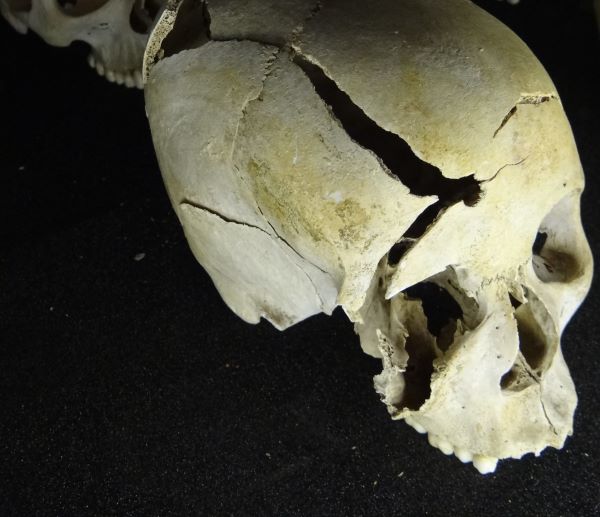
Photo Credit: Skulls of Genocide Victims: Genocide Memorial Center – Kigali, Rwanda, ’01 by Adam Jones, Ph.D. – Global Photo Archive. Licensed under CC BY SA 2.0
Published 11 April 2024
About Thinking Out Loud
Thinking Out Loud is a commentary series by Lara Kajs examining international law, humanitarian crises, and the prevention of mass atrocities. Drawing on field experience in conflict and displacement settings, the column explores the legal and policy challenges that shape contemporary conflicts
Lara Kajs is the founder and executive director of The Genocide Report, a Washington, DC-based educational nonprofit focused on atrocity prevention and international law. She is the author of several field-based books on conflict, displacement, humanitarian crises, and international humanitarian law, drawing on extensive research and field experience in Yemen, Syria, and Afghanistan. Her writing and public speaking focus on atrocity crimes, forced displacement, the protection of civilians, and the legal frameworks governing armed conflict.