By Lara Kajs
Thinking Out Loud
This piece situates Russia’s war against Ukraine within the broader international legal and strategic framework. It highlights the global consequences of unchecked aggression, from food security to the precedent it sets for other authoritarian leaders. Kajs frames the discussion as both a humanitarian and policy imperative, emphasizing the need for decisive international action to defend sovereignty, human rights, and the rule-based order.
Since World War II, the international system has operated on rules designed to govern state behavior. Sovereign nations are entitled to live peacefully, exercise their rights, and be free from invasion. Yet for over a year, Vladimir Putin’s war has subjected Ukraine—a peaceful neighbor—to sustained violence and atrocities, challenging the very foundations of this rule-based order.
This is not Putin’s first assault on Ukraine. In 2014, Russia seized portions of Ukrainian territory, slowing Kyiv’s Euro-Atlantic integration. The Minsk Protocol temporarily paused the violence, requiring Ukraine to accept territorial losses. But Russia learned from that experience: force could achieve strategic goals with minimal consequence.
It’s All About the Land
Putin’s ambition is imperial. He envisions a Russia that spans the Arctic to the Black Sea, and historically included Alaska, Hawaii, and parts of California. The vision is rooted in maps that no longer exist. Yet each invasion of Ukraine reinforces his quest for territory—regardless of the human cost or violations of international law.
Arguments framing Putin’s actions as a Cold War revival ignore the vastly different global landscape today. Power is dispersed: India, the European bloc, Africa, South America, and Asia are influential, economically significant, and in some cases, nuclear-capable. China’s GDP dwarfs that of the former Soviet Union at its peak. The twenty-first century presents challenges—conflict, crises, climate—that require cooperative global solutions, not unilateral aggression
Global Reach
Ukrainians have demonstrated remarkable resilience and unity, defying Putin’s expectations of a swift victory. Yet instability in Europe carries global consequences. Ukraine, the “world’s breadbasket,” produces critical grain for the Middle East and Africa. The war has disrupted trade, deepening food insecurity for vulnerable populations abroad.
Deeper Consequence
Beyond immediate humanitarian impacts, Putin’s war sets a dangerous precedent. It signals to other authoritarian leaders that territorial conquest may proceed with impunity. Xi Jinping’s posture toward Taiwan mirrors this threat: both dictators undermine democracy, exploit aggression, and attempt to rewrite the international order through intimidation and force.
The Nuclear Threat
Russia possesses the world’s largest nuclear arsenal. While the conflict has not escalated to nuclear use, the threat shapes international strategy. Strategic positioning has remained largely stable, but the potential for nuclear escalation constrains NATO involvement. Russia’s suspension of the New START Treaty reinforces deterrence.
Leverage
The war is far from over. Ukraine needs advanced fighter jets, long-range missiles, fortified defenses, and comprehensive training—modernization amid active conflict is urgent and complex. Russian forces must be held at a disadvantage to prevent renewed offensives. Putin has already lost roughly 60 percent of his combat power, but without decisive sanctions and enforcement, Russia could rebuild.
Lasting security requires multilateral guarantees. The U.S., Germany, France, the U.K., and the EU must commit to defending Ukrainian sovereignty. Only then can Ukraine pursue Euro-Atlantic integration once hostilities end.defending
Peace for Ukraine
Ukrainians endure war crimes and crimes against humanity: sexual violence—including against children—forced deportations, torture, starvation, and mass executions. Millions remain displaced, with basic services severely limited. Humanitarian aid is sporadic, and civilian life remains under siege.
A peace settlement is essential—not just to end the war, but to protect human life, reaffirm international law, and deter future aggression. The world must act decisively: Putin’s ambitions cannot be allowed to succeed.
Published 28 February 2023
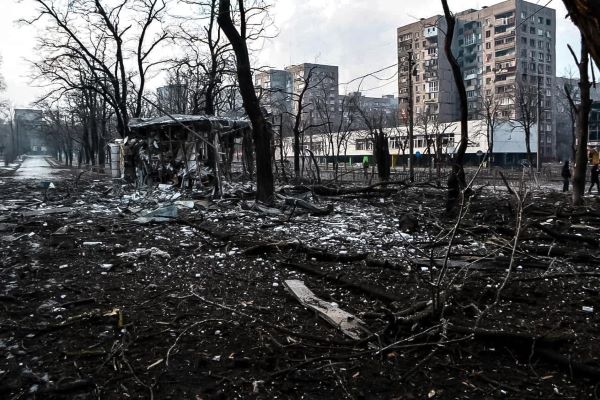
Photo credit: A street in Mariupol during the siege of the city in the course of the 2022 Russian invasion of Ukraine. War damages in Mariupol, 12 March 2022 (01) by Ministry of Internal Affairs of Ukraine. Licensed under CC by 4.0
About Thinking Out Loud
Thinking Out Loud is a commentary series by Lara Kajs examining international law, humanitarian crises, and the prevention of mass atrocities. Drawing on field experience in conflict and displacement settings, the column explores the legal and policy challenges that shape contemporary conflicts
Lara Kajs is the founder and executive director of The Genocide Report, a Washington, DC-based educational nonprofit focused on atrocity prevention and international law. She is the author of several field-based books on conflict, displacement, humanitarian crises, and international humanitarian law, drawing on extensive research and field experience in Yemen, Syria, and Afghanistan. Her writing and public speaking focus on atrocity crimes, forced displacement, the protection of civilians, and the legal frameworks governing armed conflict.