
By Lara Kajs
Thinking Out Loud
Amid the continual rise in mass shootings across the United States, this piece examines the patterns, causes, and policy debates that follow these tragedies. It challenges common assumptions about mental health, explores the role of access to firearms, and calls for a more honest and effective national response.
If it feels like there is a mass shooting in America every day, it’s because there is. The Gun Violence Archive documented 155 mass shootings in 2023 within just the first 104 days of the year. On Monday, 10 April alone, two shootings occurred within a mile of each other in Louisville, Kentucky, just hours apart, leaving seven people dead and ten injured.
The FBI defines a mass shooting—also referred to as an active shooter incident—as an event in which one or more individuals are actively engaged in killing or attempting to kill people in a populated area with a firearm. While the FBI does not set a minimum number of victims, the Investigative Assistance for Violent Crimes Act of 2012 defines a mass killing as three or more people killed or injured in a single event.
In the aftermath of these tragedies, the national response follows a familiar pattern. Two issues dominate the conversation: gun reform and mental health. The phrase “thoughts and prayers” is offered, while discussions around policy are often deferred as “too soon.” The question remains—when is the right time? Because if we continue to delay meaningful action, one thing is certain: the shootings will continue.
If it feels like there is a mass shooting in America every day, it’s because there is.”
A Deeply Divided Nation
In a country where the right to bear arms is constitutionally protected, there are approximately 400 million firearms in civilian hands—more than the nation’s population. Over the past fifty years, more Americans have died from gun violence than in all U.S. wars combined. Since 2000 alone, roughly 750,000 people have died from firearm-related injuries, with millions more wounded.
Reform proposals include raising the legal age to purchase firearms, strengthening background checks, reinstating a ban on assault-style weapons, and implementing red flag laws. These laws allow temporary restrictions on firearm access for individuals deemed at risk of harming themselves or others—even in the absence of a criminal record. Preventative measures like these have the potential to reduce future violence.
Calls to reinstate an assault weapons ban have grown louder since Sandy Hook in 2012 and have intensified following more recent tragedies in Nashville and Louisville. Meanwhile, opposition groups, including the National Rifle Association, continue to resist restrictions, citing Second Amendment protections and rejecting compromise.
Mental Health—or Something More?
Mental health is often cited as the primary cause of mass shootings. But the data tells a more complex story. Approximately 53 million Americans—about 20 percent of the population—meet the criteria for at least one mental health condition. Yet, nearly 98 percent will never commit a violent act.
An FBI analysis of 63 active shooters found that fewer than 25 percent had a diagnosed mental illness. Even more striking, research suggests that eliminating mental illness as a factor would reduce mass violence by only about 3 percent. In other words, the overwhelming majority of these incidents would still occur.
So what drives these acts? In many cases, it is grievance, rage, and crisis. Active shooters often plan their attacks over weeks or months, leaving behind manifestos, maps, and detailed preparations. These are rarely spontaneous acts—they are deliberate and calculated.
We have normalized a level of violence that would be unthinkable elsewhere.”
Lessons from Tragedy
Mental health is often cited as the primary cause of mass shootings. But the data tells a more complex story. Approximately 53 million Americans—about 20 percent of the population—meet the criteria for at least one mental health condition. Yet, nearly 98 percent will never commit a violent act.
An FBI analysis of 63 active shooters found that fewer than 25 percent had a diagnosed mental illness. Even more striking, research suggests that eliminating mental illness as a factor would reduce mass violence by only about 3 percent. In other words, the overwhelming majority of these incidents would still occur.
So what drives these acts? In many cases, it is grievance, rage, and crisis. Active shooters often plan their attacks over weeks or months, leaving behind manifestos, maps, and detailed preparations. These are rarely spontaneous acts—they are deliberate and calculated.
Common Ground Solutions
Across many cases, recurring failures emerge: easy access to firearms, particularly high-capacity weapons; exposure to extremist ideologies; missed warning signs; and inaction by institutions or individuals who recognize those signs.
Proposals to arm teachers as a deterrent have gained attention, but they are widely opposed by educators, parents, and students. Classrooms are complex environments, and introducing firearms increases risk rather than reducing it.
Similarly, the widespread availability of weapons designed for combat raises serious concerns. These firearms are engineered for maximum lethality—not civilian use. The scale of destruction they enable in seconds is incompatible with public safety.
The question is not whether rights exist—but how they are exercised responsibly.
A Final Question
We have normalized a level of violence that would be unthinkable elsewhere. Communities mourn, conversations repeat, and little changes.
So the question is simple: can we be sensible about this?
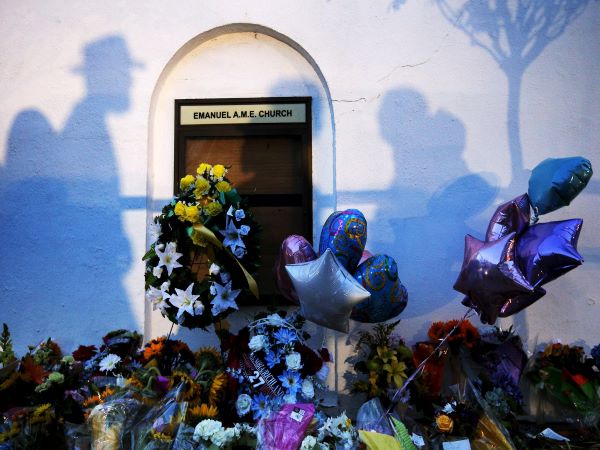
Photo Credit: Bystanders and mourners cast shadows on the walls and the memorial at the Emanuel African Methodist Episcopal Church in Charleston, South Carolina, on 18 June 2015, a day after a mass shooting left nine dead during a Bible study at the church. “Image” by zackcarlson1 is marked with Public Domain 1.0
Published 14 April 2023
About Thinking Out Loud
Thinking Out Loud is a commentary series by Lara Kajs examining international law, humanitarian crises, and the prevention of mass atrocities. Drawing on field experience in conflict and displacement settings, the column explores the legal and policy challenges that shape contemporary conflicts
Lara Kajs is the founder and executive director of The Genocide Report, a Washington, DC-based educational nonprofit focused on atrocity prevention and international law. She is the author of several field-based books on conflict, displacement, humanitarian crises, and international humanitarian law, drawing on extensive research and field experience in Yemen, Syria, and Afghanistan. Her writing and public speaking focus on atrocity crimes, forced displacement, the protection of civilians, and the legal frameworks governing armed conflict.