By Lara Kajs
Thinking Out Loud
Iranian women are leading a bold, sustained movement for freedom, challenging restrictive laws and entrenched gender inequality. From grassroots acts of defiance to global digital amplification, the protests demonstrate how modern technology exposes human rights abuses and empowers mass mobilization.
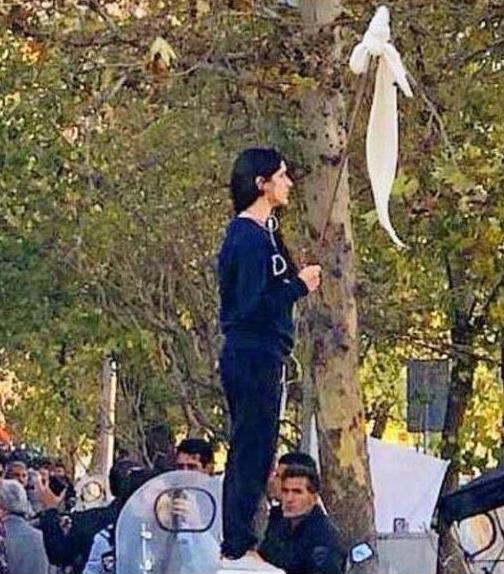
On 27 December 2017, Vida Movahed stood on a utility box on Revolution Street in Tehran, dangling a white headscarf on a stick in protest of Iran’s compulsory hijab law. An hour later, she was arrested. Images of her defiance went viral. A month later, graduate student Narges Hosseini followed the same path, and soon many others joined, launching what became known as “The Girls of Revolution Street.” Momentum has only grown—the revolution is here.
For months, civil disobedience has challenged entrenched norms, demanding the removal of the compulsory hijab and broader rights for women. Protesters aim to dismantle gender-based oppression, claim public and political space long denied, and assert personal freedoms.
Challenging the Norms
Iranian women face structural inequality daily. Restrictions on inheritance, court testimony, divorce, travel, employment, and education impose systemic barriers. Despite this, women pursue education, professional careers, political participation, and freedom of movement. Their determination predates the high-profile death of Mahsa Amini while in morality police custody—a tragic event that further galvanized the movement.
State narratives dismiss protests as foreign-instigated “riots,” yet the vast majority of demonstrators are unarmed and peaceful. Security forces have arrested over 15,000 people, some as young as twelve, and killed at least 400 protesters, with some estimates far higher. Bail and detention practices are weaponized to suppress dissent. Narges Hosseini, for example, faced bail of USD 135,000 in 2018 and was detained again in 2022 without formal charges. Court records indicate she was sentenced on 21 September 2022 to three years and six months in prison under charges of “Propaganda against the State – Article 500 IPC” and “Membership in organizations that aim to disrupt national security – Article 499 IPC.”
Courts, heavily influenced by security forces, impose harsh sentences through sham trials. Since 2017, women opposing the compulsory hijab have collectively received 92 years in prison.
Technology and Global Witnessing
Unlike previous eras of activism, today’s Iranian protests are broadcast globally in real time. Social media, news outlets, and mobile devices ensure that videos, images, and firsthand accounts travel instantly, making the struggles of Iranian women visible to the world. Technology exposes abuses, mobilizes international solidarity, and pressures both the Iranian government and global policymakers. Atrocities can no longer be hidden; courage and oppression alike are witnessed as they unfold.
Iranian women risk everything to march, chant, and demand freedom—proving that in the digital age, atrocities cannot be hidden.”
Woman, Life, Freedom
The movement resonates beyond Iran. Globally, feminists and human rights advocates recognize its courage and strategy. Iranian women risk everything to march, assemble, and chant “Woman, Life, Freedom.” Their struggle has inspired athletes, artists, and activists worldwide, including the Iranian national team’s silent protest during the World Cup anthem—a signal of solidarity that transcends borders.
The revolution is not abstract. It is being lived, documented, and broadcast. It is a reminder that oppression cannot remain unseen, and that global awareness can support accountability, solidarity, and ultimately, justice. The revolution has arrived, and it IS being televised… globally.
Photo Credit: Vida Movahed by Nazilai – licensed under CC by SA-4.0
Published December 14, 2022
Atrocity Prevention Lens
Iran’s ongoing crackdown highlights how state violence against civilians escalates risks of mass atrocity. International monitoring, rapid reporting of abuses, and coordinated advocacy are essential to protect populations and prevent systemic human rights violations. Transparency and attention from the global community can deter further escalation and empower civil society.
Legal Framework
Under international law, states are obliged to prevent, punish, and refrain from committing crimes against humanity or other atrocities. The treatment of protestors, arbitrary detentions, and systemic gender oppression in Iran violate core principles of human rights law, including the International Covenant on Civil and Political Rights and relevant UN conventions. Legal accountability remains limited, but these frameworks provide a basis for monitoring, advocacy, and potential future recourse.
Policy & Accountability Implications
Policymakers must recognize the intersection of digital amplification and civil resistance. Supporting international monitoring, imposing accountability measures, and leveraging diplomatic pressure can reinforce norms against abuse and protect vulnerable populations. Coordinated strategies should prioritize civilian safety, gender equality, and the protection of fundamental rights to ensure sustainable societal change.
About Thinking Out Loud
Thinking Out Loud is a commentary series by Lara Kajs examining international law, humanitarian crises, and the prevention of mass atrocities. Drawing on field experience in conflict and displacement settings, the column explores the legal and policy challenges that shape contemporary conflicts.
Lara Kajs is the founder and executive director of The Genocide Report, a Washington, DC-based educational nonprofit focused on atrocity prevention and international law. She is the author of several field-based books on conflict, displacement, humanitarian crises, and international humanitarian law, drawing on extensive research and field experience in Yemen, Syria, and Afghanistan. Her writing and public speaking focus on atrocity crimes, forced displacement, the protection of civilians, and the legal frameworks governing armed conflict.