By Lara Kajs
Thinking Out Loud
This piece examines Iran’s long-standing restrictions on women attending sporting events, analyzing the political, legal, and social dynamics behind the policy and its broader implications for gender equality.
Iran’s National Security Council has announced that female spectators may be permitted to attend football matches in stadiums—potentially ending a decades-long, unofficial ban often described as “No Girls Allowed.” While the decision signals a possible shift, implementation remains uncertain, and past patterns suggest that access may continue to be restricted in practice.
For decades, women and girls in Iran have been barred from attending sporting events in stadiums, despite being allowed to participate in national celebrations and political gatherings in the same venues. The inconsistency underscores a broader system of control rather than a clearly defined legal framework.
An Unwritten Ban, Rigorously Enforced
According to Mehdi Taj, head of Iran’s football federation, a task force composed of government ministries and security bodies is still determining how the policy will be implemented. In practice, this leaves open the possibility that restrictions will persist under new administrative mechanisms.
Notably, the prohibition on women attending stadiums has never been codified into formal law. Instead, it has been enforced through directives and institutional practices, raising serious questions about legality and accountability.
Historical Regression in Women’s Rights
Women’s rights in Iran expanded under Reza Shah and later Mohammad Reza Pahlavi. However, following the Iranian Revolution, policies shifted dramatically.
Under Ruhollah Khomeini, restrictions were introduced that limited women’s public participation, including barring them from attending sporting events. While framed as cultural or moral considerations, these measures effectively institutionalized gender-based exclusion.
Authorities have long justified the ban by citing the “unsuitable” atmosphere of stadiums—ranging from profanity among male fans to the attire of male athletes. These arguments, however, have been inconsistently applied. Women have been permitted to watch matches on television since the late 1980s, undermining the stated
Moments of Defiance
Public resistance to the ban has surfaced repeatedly.
In 2005, thousands of women gathered outside a stadium in Tehran during a World Cup qualifier. Several thousand were admitted, while others forced their way inside—marking one of the first large-scale challenges to the restriction.
Such moments have exposed divisions within Iran’s political establishment, particularly between reformist and conservative factions, and have often triggered backlash from clerical authorities.
International Pressure and Selective Compliance
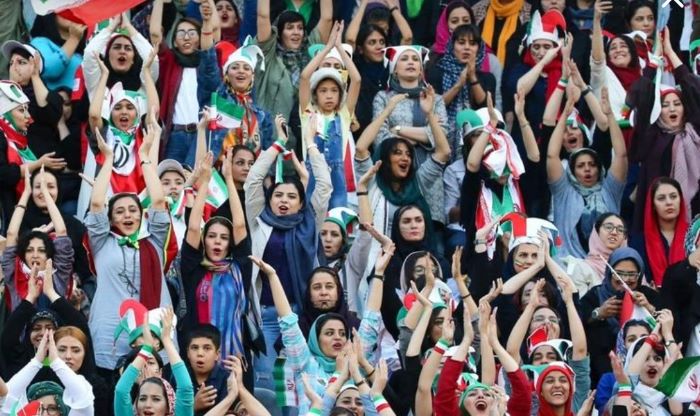
Global governing bodies, including FIFA, prohibit discrimination among spectators and have pressured Iran for more than a decade to allow women full access to stadiums. In response, Iran has offered only limited and highly controlled concessions, such as permitting small, pre-selected groups of women to attend matches, restricting ticket availability, and reversing access without notice. In 2019, following a FIFA-imposed deadline, authorities allowed a limited number of women into Tehran’s Azadi Stadium for a World Cup qualifier. While this move was described as progress, such measures have largely been symbolic rather than systemic.
The Cost of Exclusion
The enforcement of the ban has led to arrests, violence, and, in some cases, трагic outcomes.
In 2019, Sahar Khodayari—known as “The Blue Girl”—died after self-immolating outside a Tehran courthouse. She had been facing prison time for attempting to enter a stadium disguised as a man.
In 2022, in Mashhad, hundreds of women who had legally purchased tickets for a World Cup qualifier were denied entry. Security forces responded with pepper spray and tear gas when the women protested. Several were injured.
Authorities later attributed the incident to “invalid tickets,” a claim widely disputed by those present.
Symbolism and Resistance
Restrictions on stadium access have become a broader symbol of gender inequality in Iran. The issue is no longer limited to sport—it reflects systemic limitations on women’s participation in public life.
The movement Woman, Life, Freedom has reinforced this connection, linking everyday restrictions to greater demands for rights and autonomy.
A Conditional Shift
Iran now claims it is moving toward lifting the ban. However, without transparent implementation and equal access, the policy change risks remaining largely performative.
Allowing limited numbers of women into stadiums—under controlled conditions—does not constitute full access. Until women can freely purchase tickets and enter stadiums without restriction, the ban effectively remains in place.
Photo Credit: Female spectators at Azida Stadium, Iran by Maryam Takhtkeshiam. Licensed under CC 4.0
Published 8 September 2023
About Thinking Out Loud
Thinking Out Loud is a commentary series by Lara Kajs examining international law, humanitarian crises, and the prevention of mass atrocities. Drawing on field experience in conflict and displacement settings, the column explores the legal and policy challenges that shape contemporary conflicts
Lara Kajs is the founder and executive director of The Genocide Report, a Washington, DC-based educational nonprofit focused on atrocity prevention and international law. She is the author of several field-based books on conflict, displacement, humanitarian crises, and international humanitarian law, drawing on extensive research and field experience in Yemen, Syria, and Afghanistan. Her writing and public speaking focus on atrocity crimes, forced displacement, the protection of civilians, and the legal frameworks governing armed conflict.