By Lara Kajs
Thinking Out Loud
This article examines the debate over a ceasefire in Gaza, focusing on U.S. policy at the UN Security Council, the humanitarian situation on the ground, and the legal and political implications of delaying a cessation of hostilities.
The United States has vetoed a United Nations Security Council resolution calling for an immediate ceasefire in Gaza, marking the third time it has blocked such a measure. U.S. officials have argued that a ceasefire at this stage could undermine ongoing negotiations to secure the release of hostages and potentially prolong the conflict.
Of the Council’s fifteen members, thirteen voted in favor of the resolution, while the United Kingdom abstained. The United States cast the sole veto. U.S. Ambassador to the United Nations Linda Thomas-Greenfield stated that it was not the “right time” for a ceasefire.
The question of timing, however, is central to the humanitarian reality on the ground.
By this stage of the conflict, approximately 1.9 million Palestinians—more than 80 percent of Gaza’s population—had been displaced. Many were living in makeshift shelters with limited access to food, clean water, and medical care. Humanitarian conditions had deteriorated rapidly, with aid delivery severely constrained.
Civilian casualties had also risen significantly, with reports indicating that a substantial proportion of those killed were women and children. These conditions intensified calls from humanitarian organizations and member states for an immediate cessation of hostilities to allow for the delivery of aid and the protection of civilians.
Ceasefire and the Law of Armed Conflict
Debates surrounding a ceasefire often intersect with questions of military necessity and the right to self-defense. However, under international humanitarian law, even lawful military operations are subject to constraints, including the principles of distinction, proportionality, and precaution.
Allegations emerging from Gaza—including the obstruction of humanitarian aid, attacks on civilian infrastructure, and the scale of civilian harm—have raised serious legal concerns among international observers and legal experts.
Whether these actions constitute war crimes, crimes against humanity, or other violations is ultimately a matter for legal determination. However, the volume and consistency of such allegations have contributed to increasing international pressure for a ceasefire.
The Limits of the Security Council
The United Nations Security Council remains the only body capable of passing legally binding resolutions requiring a ceasefire. In contrast, resolutions adopted by the General Assembly, while politically significant, do not carry the same legal force.
This distinction underscores the importance of Security Council action—and the implications of its absence.
The United States has proposed an alternative resolution that calls for a temporary ceasefire linked to the release of hostages, alongside provisions for increased humanitarian access and opposition to any forced displacement or demographic change in Gaza.
However, questions remain regarding the timing, conditions, and durability of such a ceasefire. A temporary pause tied to specific conditions may alleviate immediate suffering but does not necessarily address the longer-term trajectory of the conflict.
The question is no longer only whether a ceasefire is justified, but whether the international system can respond effectively to a humanitarian crisis.”
Rafah and Escalation Risks
At the time of the proposed ceasefire, more than one million displaced Palestinians had sought refuge in Rafah, a city in southern Gaza with limited infrastructure to support such a population increase.
Humanitarian agencies warned that a ground offensive in Rafah could result in catastrophic civilian casualties, given the density of the population and the lack of safe alternatives for displacement.
The prospect of further escalation also raised broader concerns about regional stability and the potential for the conflict to expand beyond Gaza.
U.S. Policy and Leverage
As Israel’s primary ally, the United States holds significant diplomatic and strategic influence. This has led to growing calls—both domestically and internationally—for Washington to use that leverage to shape the course of the conflict.
Balancing support for an ally with adherence to international humanitarian principles presents a complex policy challenge. At the same time, the scale of the humanitarian crisis has intensified scrutiny of U.S. decision-making at the Security Council.
Historical parallels, including reflections on past failures to prevent mass atrocities, continue to inform these debates. They raise enduring questions about when and how states choose to act in the face of large-scale human suffering.
The Case for a Ceasefire
An immediate cessation of hostilities could facilitate the delivery of humanitarian aid, reduce civilian casualties, create space for diplomatic negotiations, and support efforts to secure the release of hostages. Each of these outcomes addresses urgent humanitarian and strategic concerns. At the same time, the durability of any ceasefire ultimately depends on the political will of the parties involved, as well as the commitment of the broader international community to sustain it.
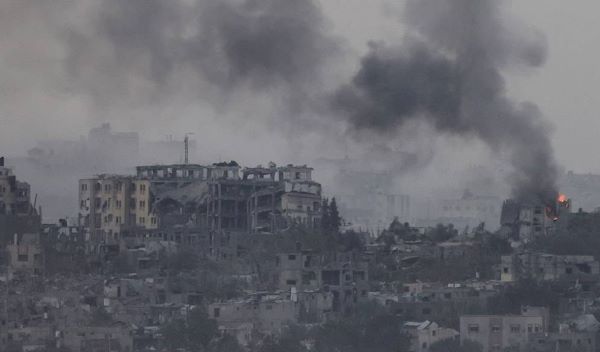
Photo credit: Gaza War Damage 2023 by Tasnim News Agency. Licensed under CC by SA 4.0
Published 23 February 2024

About Thinking Out Loud
Thinking Out Loud is a commentary series by Lara Kajs examining international law, humanitarian crises, and the prevention of mass atrocities. Drawing on field experience in conflict and displacement settings, the column explores the legal and policy challenges that shape contemporary conflicts
Lara Kajs is the founder and executive director of The Genocide Report, a Washington, DC-based educational nonprofit focused on atrocity prevention and international law. She is the author of several field-based books on conflict, displacement, humanitarian crises, and international humanitarian law, drawing on extensive research and field experience in Yemen, Syria, and Afghanistan. Her writing and public speaking focus on atrocity crimes, forced displacement, the protection of civilians, and the legal frameworks governing armed conflict.