
By Lara Kajs
Thinking Out Loud
The Abraham Accords, signed in 2020, were hailed as a landmark diplomatic achievement in the Middle East. Yet, five years later, ongoing crises—including the humanitarian catastrophe in Gaza—illustrate the limitations of agreements that sideline justice, human rights, and accountability
Peace Without Palestine
A core criticism of the Abraham Accords is that they bypassed the Palestinian question. Arab states that once conditioned normalization on progress toward resolving the Israeli-Palestinian conflict, chose instead to establish ties without securing concessions for Palestinians.
Peace agreements that bypass justice and human rights may appear successful diplomatically, but on the ground, they often magnify suffering and perpetuate instability.”
Palestinians were excluded from the negotiations and view the accords not as a pathway to peace, but as a diplomatic circumvention that undermines their national aspirations for self-determination. From an international law perspective, self-determination is a right, not a reward.
The Israeli government, in turn, advanced normalization without addressing the occupation, settlement expansion, displacement, or Palestinian political rights. While the agreements brought limited economic and security benefits, they redefined regional calculus: Arab solidarity with Palestine was no longer a prerequisite for diplomatic relations with Israel. Without addressing the root causes of the conflict, these agreements could not produce sustainable peace.
Gaza: From Catalyst to Humanitarian Catastrophe
On 7 October 2023, Hamas launched an unprecedented attack on southern Israel, resulting in over a thousand civilian deaths and hostage-taking. Israel responded with a sustained military campaign in Gaza, which has persisted for over 700 days. Reports indicate at least 65,000 Palestinian deaths, with women and children comprising the majority. Field analysts, humanitarian professionals, and satellite imagery suggest the toll could be significantly higher, though verification remains difficult due to restricted access for investigators.
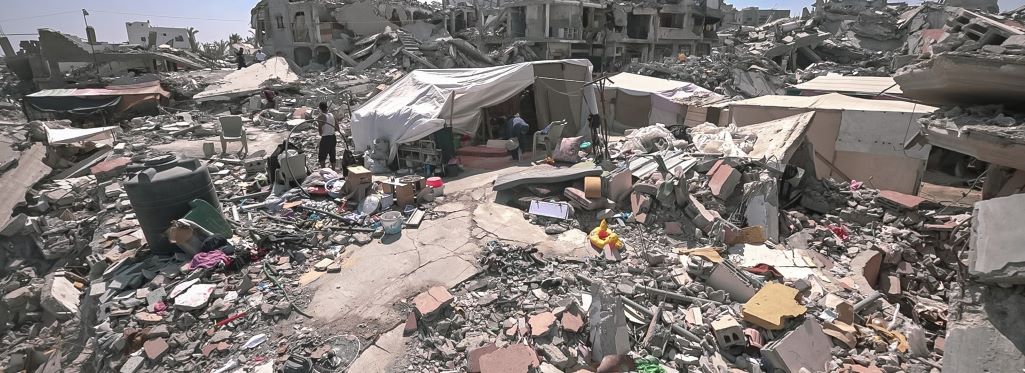
Critical infrastructure—including hospitals, schools, refugee camps, homes, and mosques—has been destroyed. More than 90% of Gaza has sustained damage, with repeated displacements of the population and a blockade restricting food, water, fuel, and medical supplies, producing severe humanitarian conditions.
Warnings and International Law
By early 2024, UN reports, TGR, Human Rights Watch, Amnesty International, and independent experts identified the situation as meeting the criteria for genocide under the 1948 Genocide Convention:
“…acts committed with intent to destroy, in whole or in part, a national, ethnical, racial or religious group.”
Statements by Israeli officials, including high-ranking ministers, and documented actions such as mass displacement, targeting of civilian infrastructure, and the use of starvation as a weapon have underscored concerns regarding intent. Yet, international response was limited, leaving Palestinians vulnerable to sustained violence.
Regional Stability and Accountability
Rather than fostering peace, the Abraham Accords contributed to regional insecurity by rewarding normalization without addressing the occupation or Palestinian statehood. Israel pursued aggressive military actions, emboldened by diplomatic and material support from the United States and other partners. Meanwhile, international mechanisms such as the UN Security Council were largely deadlocked, and Palestinian leadership remained fragmented.
In 2025, multiple international courts, including the International Court of Justice, initiated proceedings to examine whether actions in Gaza constitute genocide. These efforts mark important steps toward accountability, though enforcement remains a significant challenge.
Since October 2023 and throughout 2025, Gaza has been the epicenter of what a United Nations Commission of Inquiry (COI) determined to be genocide. Once symbolic of potential peace, the Abraham Accords now cast a long shadow, representing not just a missed opportunity but a strategic shift that emboldened hardline policies and marginalized Palestinian voices to catastrophic effect.
Lessons and Legal Imperatives
The Abraham Accords, while presented as a historic peace, sidestepped justice and self-determination. The subsequent humanitarian crisis in Gaza illustrates that peace agreements lacking inclusion, accountability, and attention to human rights cannot produce sustainable stability. International law provides frameworks for protecting populations and ensuring state responsibility, and these frameworks must guide both regional diplomacy and global response.
The situation underscores a clear principle: lasting peace requires justice, security must include dignity, and diplomacy must incorporate accountability. As the international community observes the ongoing crisis, the lesson is evident: ignoring structural injustice and human rights leads to preventable suffering.
Connecting to Current Policy Debates
The lessons of Gaza and the Abraham Accords have broader implications for contemporary Middle East policy. Debates over Iran’s nuclear ambitions, ongoing instability in Yemen, and international responses to humanitarian crises in Gaza and Lebanon illustrate that unilateral agreements or interventions that ignore rights, accountability, and local realities risk exacerbating conflict. Policymakers must consider how diplomatic initiatives intersect with human rights obligations, regional stability, and international law—otherwise, history shows that well-intentioned strategies can unintentionally fuel suffering and undermine long-term security.
Published 2 October 2025
Photo Credit: Gaza War 2023 – 2025: IMG 8181 by Jaber Badwan. Licensed under CC BY SA 4.0
About Thinking Out Loud
Thinking Out Loud is a commentary series by Lara Kajs examining international law, humanitarian crises, and the prevention of mass atrocities. Drawing on field experience in conflict and displacement settings, the column explores the legal and policy challenges that shape contemporary conflicts.
About the Author
Lara Kajs is the founder and executive director of The Genocide Report, a Washington, DC-based educational nonprofit focused on atrocity prevention and international law. She is the author of several field-based books on conflict, displacement, humanitarian crises, and international humanitarian law, drawing on extensive research and field experience in Yemen, Syria, and Afghanistan. Her writing and public speaking focus on atrocity crimes, forced displacement, the protection of civilians, and the legal frameworks governing armed conflict.