
By Lara Kajs
Thinking Out Loud
In August 2021, as Kabul collapsed and tens of thousands of Afghans rushed toward Hamid Karzai International Airport seeking evacuation, a suicide bombing at Abbey Gate killed 13 U.S. service members and more than 170 Afghan civilians. The attack marked one of the deadliest moments of the evacuation and a defining episode in the final days of the twenty-year war in Afghanistan.
The Collapse of Kabul
Some moments in conflict become fixed in memory not because they were anticipated, but because history seemed to accelerate around them.
In August 2021, I was in Kabul investigating human rights violations against women and girls allegedly committed by the Taliban, and potential atrocity crimes connected to the conflict in Afghanistan. Within days, however, the political and military situation deteriorated at a speed few had expected.
By 13 August, we were receiving reports that provincial capitals were falling rapidly to Taliban forces. Our team was advised to remain in Kabul as the situation across the country became increasingly unstable.
Two days later, on the morning of 15 August, we were instructed to leave our hotel and proceed immediately to Hamid Karzai International Airport. That same day, we learned that Afghan President Ashraf Ghani had fled the country. Soon afterward, Taliban fighters entered Kabul.
The collapse of the Afghan government triggered an immediate humanitarian emergency. Tens of thousands of civilians began moving toward the airport, hoping to secure passage out of the country before the new regime consolidated control.
Many of them had worked with the United States or allied governments during the two-decade war. Others were journalists, civil society leaders, or members of communities that feared retaliation under Taliban rule. For many families gathered outside the airport gates, evacuation was no longer a matter of opportunity—it was a matter of survival.
The Airfield
The following day, the pressure of the crowds overwhelmed the airport perimeter. Thousands of civilians pushed through barriers and flooded onto the airfield itself. Images from that day quickly circulated around the world: Afghans running alongside departing aircraft, some attempting to climb onto the fuselage or landing gear of military transport planes as they prepared for takeoff.
From a distance, we watched as several individuals fell from a departing aircraft shortly after it left the runway.
One U.S. military officer who had been present at Ground Zero on September 11 later told me that the sight of bodies falling from the aircraft reminded him of the moment people began jumping from the towers in New York. The comparison reflected the emotional strain that many personnel on the ground were experiencing during those first chaotic days.
In the days that followed, the airport became the center of an unprecedented evacuation effort. Military personnel, diplomats, humanitarian workers, and volunteers worked continuously to process and move as many people as possible through the gates.
Flights departed around the clock. At times, nearly 10,000 people were airlifted out of Afghanistan in a single day.
Yet outside the airport perimeter, the crowds never seemed to diminish.
Outside the Gates
For many Afghans trying to reach the airport, the journey itself was dangerous.
Taliban checkpoints quickly formed along the roads leading to the gates. Civilians attempting to approach the airport were frequently stopped, beaten, or forced to turn back. Reports of violence against people attempting to flee became increasingly common.
From inside the airport, we could see the desperation in the crowds gathering outside the perimeter. Families waited for hours, sometimes days, hoping their names would be called or that an opportunity might appear.
The evacuation operation was immense in scale, but the number of people seeking escape was even larger.
Every day, the question remained the same: how many people could realistically be moved through the gates before the evacuation ended?
A Known Threat
By late August, the evacuation had concentrated around a limited number of entry points, including Abbey Gate.
Security officials understood the vulnerability the gate represented. Tens of thousands of civilians crowded into narrow approach routes, creating conditions that were extremely difficult to secure.
Intelligence briefings warned repeatedly that ISIS-K militants were seeking to attack the airport.
Several governments issued public advisories urging their nationals to avoid the Abbey Gate area because of the credible threat of a suicide bombing. Yet for thousands of Afghans hoping to leave the country, the risk of approaching the gate was outweighed by the danger of remaining outside Taliban control.
The crowds continued to gather.
The Abbey Gate Bombing
At approximately 5:36 p.m. on 26 August 2021, an ISIS-K suicide bomber named Abdul Rahman al-Logari detonated an explosive device near Abbey Gate.
The blast occurred in the middle of a densely packed crowd of civilians and military personnel waiting near the entrance.
There was first a flash, followed by the shockwave of the explosion.
For a moment, there was confusion across the airfield as personnel attempted to determine whether the blast signaled a larger coordinated attack on the airport. Within minutes, it became clear that a suicide bombing had taken place at the gate.
The attack killed thirteen U.S. service members and more than 170 Afghan civilians. Hundreds more were wounded. The device had been packed with ball bearings intended to maximize casualties. In the tightly compressed crowd near the gate, the blast caused devastating injuries.
For those of us nearby, the aftermath was difficult to absorb. Even individuals with extensive combat experience struggled to process what had just occurred.
Yet within minutes, the evacuation effort resumed.
The Evacuation Continues
Despite the attack, aircraft continued departing Kabul in the days that followed. Security measures were tightened, and operations continued at an extraordinary pace. In less than three weeks, more than 120,000 people were airlifted out of Afghanistan—one of the largest emergency evacuations in modern history.
Among them were interpreters, journalists, civil society leaders, and thousands of Afghan civilians whose work or affiliations placed them at risk under Taliban rule.
But the evacuation also revealed its limits.
Tens of thousands of Afghans who hoped to leave were unable to secure passage. Families were separated during the chaos. Some children were placed on flights alone in the hope that they might later be reunited with relatives.
These are the quieter stories of the evacuation—stories that did not end when the last aircraft departed Kabul.
Large-scale evacuations are often remembered through numbers: flights flown, people moved, timelines completed. But the reality on the ground is far more human and far more complicated.” — Lara Kajs
After the Airlift
The Abbey Gate bombing became one of the defining moments of the final days of the war in Afghanistan. For the service members who lost their lives, the attack marked the final sacrifice during one of the most complex evacuation operations ever attempted.
For those who were present—military personnel, humanitarian workers, journalists, and Afghan civilians—the events of those days remain difficult to forget.
Large-scale evacuations are often remembered through numbers: flights flown, people moved, timelines completed. But the reality on the ground is far more human and far more complicated.
The fall of Kabul demonstrated both the extraordinary capacity of governments and institutions to mobilize during a crisis and the painful limits of what even the largest evacuation in modern history can accomplish.
For many of us who were there, the work did not end when the final aircraft left Afghanistan. Even now, years later, efforts continue to assist Afghans who remain at risk.
History will remember the airlift from Kabul as a logistical achievement carried out under extraordinary pressure. But for those who stood at the gates—watching families press forward in the hope of escape—it will also be remembered as a moment when the fate of thousands depended on whether they could make it through a single checkpoint before the doors closed.
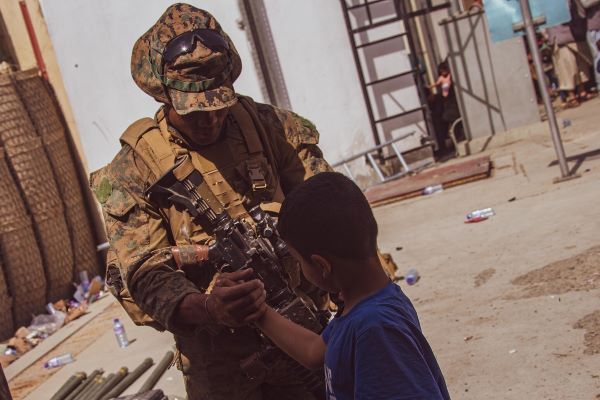
Photo Credit: A Marine assigned to the 24th Marine Expeditionary Unit teaches a child how to do a handshake on August 21 at Hamid Karzai International Airport, Kabul, Afghanistan. US Maine Corps photo by Cpl. Davis Harris. Licensed under CC BY SA 4.0
Published: 26 August 2023
Suggested Citation
Kajs, Lara. “Abbey Gate: Witness to the Fall of Kabul and the Limits of Evacuation.” Thinking Out Loud. 26 August 2023.
Atrocity Prevention Lens
Mass displacement during rapid political collapse creates environments in which civilians become acutely vulnerable. Evacuation points such as airports, border crossings, and humanitarian corridors often concentrate large populations in confined spaces, making them potential targets for armed groups seeking to maximize casualties or disrupt evacuation efforts. Understanding these risks—and incorporating civilian protection into evacuation planning—remains an important component of atrocity prevention in conflict environments.
About Thinking Out Loud
Thinking Out Loud is a commentary series by Lara Kajs examining international law, humanitarian crises, and the prevention of mass atrocities. Drawing on field experience in conflict and displacement settings, the column explores the legal and policy challenges that shape contemporary conflicts.
Lara Kajs is the founder and executive director of The Genocide Report, a Washington, DC-based educational nonprofit focused on atrocity prevention and international law. She is the author of several field-based books on conflict, displacement, humanitarian crises, and international humanitarian law, drawing on extensive research and field experience in Yemen, Syria, and Afghanistan. Her writing and public speaking focus on atrocity crimes, forced displacement, the protection of civilians, and the legal frameworks governing armed conflict.
She was present at Hamid Karzai International Airport during the August 2021 evacuation from Kabul.