
Lara Kajs
Thinking Out Loud
Washington, DC — 13 October 2026
More than four years after a United Nations-mediated truce reduced hostilities in Yemen, the country remains trapped in a protracted humanitarian emergency. Yemen’s humanitarian crisis has changed in character, but the conditions that leave millions vulnerable remain unresolved. Understanding Yemen today requires looking beyond the immediate violence to the economic, institutional, and political failures that continue to undermine civilian security and recovery.
Some places stay with you long after you leave. Yemen is one of them. Between 2018 and early 2021, I spent a total of 17 months in the war-torn country, during some of the most intense years of conflict and the heaviest Saudi-led coalition bombing. I witnessed the humanitarian crisis at close range: airstrikes, destroyed infrastructure, displacement, hunger, the effects of the cholera epidemic, and the ordinary suffering of civilians living through a war they did not choose.
My role in Yemen was to investigate atrocity crimes and interview people whose lives had been shaped by the conflict. Those experiences informed my book, Stories from Yemen: A Diary from the Field, but the questions that emerged from that work extended beyond the events I documented. What happens to a society when the immediate intensity of war diminishes, yet the conditions necessary for people to rebuild their lives remain absent?
Yemen offers a sobering answer. A decline in large-scale hostilities can create space for relief, but it does not alone restore livelihoods, functioning institutions, reliable public services, or confidence in the future. These are the conditions that determine whether a society is moving toward recovery or merely enduring a different phase of crisis.
The Difference Between Reduced Violence and Recovery
The United Nations-mediated truce that took effect in April 2022 demonstrated that reducing hostilities could produce tangible benefits. The agreement facilitated fuel imports through Hudaydah and commercial flights from Sana’a, while reduced fighting gave civilians some respite from the immediate dangers of war. Although the truce formally expired in October 2022, the relative calm that followed created an opportunity to pursue a more durable political settlement. The opportunity was never fully realized.
Yemen remained divided among competing authorities and armed actors, while the national economy continued to deteriorate. Political fragmentation weakened the institutions needed to deliver services and support economic recovery. For many households, meeting basic needs remained precarious even after the immediate threat of an airstrike or ground offensive receded.
This distinction matters because the absence of sustained large-scale fighting is not a sufficient measure of peace. A family may no longer be fleeing an active front line but still lack secure housing, reliable income, adequate health care, or consistent access to food and clean water. Children may be physically removed from immediate danger while their education is interrupted for years. Communities may remain in place while the services that make life there viable gradually disappear. A reduction in violence matters enormously. But it is a beginning, not an outcome.
A reduction in violence is not the same as recovery, and the absence of headlines is not the absence of crisis.
A Humanitarian Emergency Sustained by Structural Failure
Yemen’s humanitarian crisis is often described through the scale of need. Those figures are essential for understanding the emergency, but they do not fully explain why it has proved so difficult to reverse. The deeper problem is the interaction of conflict, economic deterioration, institutional fragmentation, and declining access to essential services.
The division of authority has complicated economic management and the delivery of public services across the country. Years of conflict have damaged infrastructure, disrupted livelihoods, and weakened the systems on which households depend. Public employees have faced prolonged uncertainty over salaries, while businesses and families have had to navigate unstable economic conditions and diminished purchasing power.
These pressures reinforce one another. When incomes become unreliable, households have less capacity to absorb increases in food prices, illness, displacement, or other shocks. When public services deteriorate, families must find alternatives they may not be able to afford. When livelihoods disappear, humanitarian assistance becomes more important—not simply because an emergency has occurred, but because the means of recovering from it have been steadily eroded.
This is one reason Yemen’s crisis cannot be resolved through emergency aid alone. Humanitarian assistance can prevent immediate suffering and help people survive. It cannot, by itself, restore a functioning economy, resolve competing political claims, or rebuild public institutions capable of providing essential services. The distinction is not an argument for reducing humanitarian assistance. It is an argument for recognizing what that assistance can and cannot accomplish.
Health and Education: The Cost of Prolonged Instability
The beginning of 2018 revealed an outbreak of cholera in which nearly one million cases affected 22 of the country’s 23 governorates. By the end of 2019, cholera cases exceeded 1.2 million. But cholera was not simply a public-health crisis. It was a manifestation of the broader collapse around it. When war disrupts water systems, sanitation, health facilities, transportation, and household resources, disease can move through the spaces conflict creates.
The consequences of prolonged crisis are particularly evident in health care. A health system cannot be judged solely by whether a hospital building remains standing or a clinic is technically open. Its effectiveness depends on trained personnel, medicines, functioning equipment, reliable electricity and water, referral systems, and the financial ability of patients to obtain treatment.
When these elements are disrupted over many years, even routine health needs can become serious threats to household stability. Preventable illnesses become harder to treat, maternal and child health services become less reliable, and outbreaks place additional pressure on already constrained facilities. Recent warnings from the World Health Organization have underscored how years of weakness leave the system especially vulnerable when violence intensifies again.
Education faces a related challenge. Conflict and economic hardship can interrupt schooling, while families struggling to meet basic needs may find it increasingly difficult to keep children in education. The consequences extend beyond missed lessons. Prolonged disruption can narrow future employment opportunities, deepen inequality, and leave another generation with fewer routes toward economic security.
These are not secondary effects that can be addressed after peace has been achieved. Health and education are part of the foundation on which recovery depends. When they deteriorate, the costs of conflict continue to accumulate long after the immediate violence subsides.
Humanitarian Aid Cannot Substitute for Political Resolution
International humanitarian organizations have helped sustain millions of people through years of conflict. Their work remains indispensable, but the humanitarian system itself operates under severe constraints. Funding shortages, access restrictions, insecurity, and the difficulty of working across divided areas of authority all affect the reach and continuity of assistance.
The United Nations’ 2026 Humanitarian Needs and Response Plan warned that funding reductions had already forced the scaling back of critical life-saving programs. It also emphasized that humanitarian action alone cannot reverse the drivers of the crisis.
This creates a damaging cycle. As needs persist, aid organizations are asked to do more with fewer resources. As essential services and household coping mechanisms weaken, more people become dependent on external assistance. Yet the political and economic conditions that generate those needs remain largely unresolved.
Humanitarian relief must continue, but it should not become a substitute for sustained diplomatic engagement or an acceptable long-term arrangement for a population living amid institutional breakdown. Nor should repeated emergency appeals obscure the responsibility of political actors to create conditions in which people can live safely and support themselves.
A credible path toward recovery must include more than agreements to reduce fighting. It requires political arrangements that can endure, institutions capable of delivering essential services, economic conditions that allow livelihoods to recover, and meaningful participation by Yemenis in decisions affecting their future. Without progress on these fronts, humanitarian assistance risks managing the consequences of a crisis that remains politically unresolved.
What Recovery Would Require
Yemen’s experience raises a broader question about how the international community defines progress in protracted conflicts. A ceasefire or truce can be an essential achievement, particularly after years of sustained violence. But if it is treated as evidence that the underlying crisis has been addressed, the measure of success becomes too narrow.
Recovery should be assessed through the conditions civilians can actually experience; whether families can access health care, whether children can attend school, whether people can earn a living, whether displaced households have viable and safe options, and whether public institutions can meet basic responsibilities. These measures do not replace the importance of ending hostilities; they help determine whether the end of hostilities is translating into something durable.
They also matter for atrocity prevention. Severe deprivation does not automatically constitute an atrocity crime, and humanitarian need alone cannot establish criminal responsibility. But prolonged insecurity, institutional weakness, discrimination, and the erosion of civilian protections can deepen vulnerability and make it harder to prevent or respond to serious violations. Monitoring these conditions is therefore part of understanding risk, not simply documenting suffering after it occurs.
Yemen should not have to wait for another major escalation to command sustained international attention. The deterioration of livelihoods, health care, education, and public institutions is consequential in its own right. These are not merely indicators of a crisis that persists; they are conditions that shape whether people can withstand the next shock.
The task is not simply to return Yemen to the relative calm that followed the 2022 truce. It is to build on the protection that reduced violence made possible and translate it into a more secure and sustainable future. That requires political commitment, resources beyond short-term emergency relief, accountability for violations of international law, and an approach to recovery that places the lives and rights of Yemenis at its center.
Peace cannot be measured only by the violence that stops. It must also be measured by whether people can rebuild their lives, exercise their rights, and trust that the conditions of survival will not collapse around them again. Yemen’s unfinished crisis is a reminder that when the guns fall quiet, but the foundations of civilian life remain broken, the work of peace is far from complete.
Photo Credit
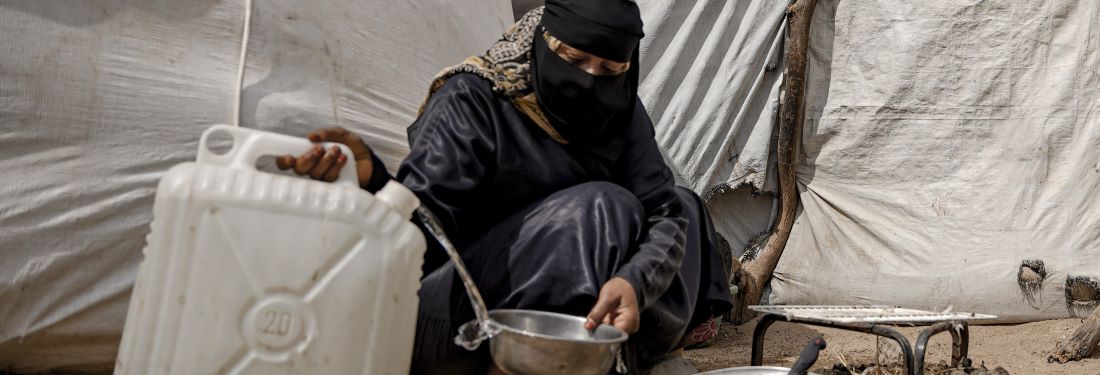
EU cash assistance for displaced communities in Yemen by EU Civil Protection and Humanitarian Aid. Licensed under CC BY-NC-ND 2.0
About Thinking Out Loud
Thinking Out Loud is a commentary series by Lara Kajs examining international law, humanitarian crises, and the prevention of mass atrocities. Drawing on field experience in conflict and displacement settings, the column explores the legal and policy challenges that shape contemporary conflicts.
About the Author
Lara Kajs is the founder and executive director of The Genocide Report, a Washington, DC-based educational nonprofit focused on atrocity prevention and international law. She is the author of several field-based books on conflict, displacement, humanitarian crises, and international humanitarian law, drawing on extensive research and field experience in Yemen, Syria, and Afghanistan. Her writing and public speaking focus on atrocity crimes, forced displacement, the protection of civilians, and the legal frameworks governing armed conflict.