
Lara Kajs
Thinking Out Loud
Humanitarian crises are often measured through numbers: displacement figures, casualty estimates, food insecurity levels, and funding shortfalls. These metrics are necessary. They help define scale, guide policy, and shape international response. But they also create distance. Over time, prolonged crises risk becoming statistical landscapes in which the daily reality of survival disappears beneath aggregated data.
Yemen is one of those crises.
After more than a decade of conflict, Yemen remains the site of one of the world’s most severe humanitarian emergencies. Millions face food insecurity, displacement, economic collapse, and restricted access to healthcare and education. Entire generations of children have grown up knowing only instability. Yet despite the scale of suffering, Yemen rarely sustains consistent international attention. The crisis persists largely in the background of global awareness—visible during moments of escalation, then quickly displaced by other geopolitical priorities.
But prolonged conflict does not simply destroy infrastructure. It reshapes the inner lives of those forced to endure it.
The experience of living within a sustained humanitarian crisis is not limited to physical survival. It alters family structures, social relationships, decision-making, memory, identity, and the psychological understanding of what it means to have a future. In environments where conflict becomes continuous rather than temporary, survival itself becomes a form of negotiation between fear, obligation, exhaustion, and dignity.
In Yemen, civilians are not only surviving war. They are surviving the long-term erosion of normal life.
The Weight of Daily Decisions
In stable societies, many decisions are made with the assumption that tomorrow will resemble today. In conflict environments, that assumption disappears. Ordinary choices become survival calculations.
Parents must decide whether to spend limited money on food, medicine, transportation, or fuel. Families weigh the risks of sending children to school against the dangers of keeping them home indefinitely. Medical treatment may require traveling through insecure areas or crossing front lines. Access to clean water may depend on whether fuel is available to operate pumps or whether humanitarian deliveries arrive on time.
These are not isolated emergencies. They are recurring conditions that shape daily existence.
For many Yemeni families, survival requires constant sacrifice—not only materially, but emotionally. Parents routinely suppress their own fear to preserve a sense of stability for their children. Adults absorb uncertainty privately because visible fear inside the home can become another source of trauma for younger generations.
In prolonged crises, people learn to function while carrying levels of stress that would otherwise be understood as unsustainable. And eventually, exhaustion becomes normalized.
The Invisible Consequences of Prolonged Conflict
The destruction caused by war is often discussed in visible terms: collapsed buildings, damaged hospitals, destroyed roads. But some of the most enduring consequences are less visible.
Prolonged exposure to conflict reshapes how people understand safety, trust, and permanence. Children raised in conflict environments may develop around patterns of instability that become psychologically routine. Airstrikes, armed checkpoints, displacement, and shortages are integrated into daily memory. Over time, a crisis stops feeling temporary.
This creates forms of psychological survival that are difficult to measure but deeply consequential. People narrow their expectations. Long-term planning becomes difficult. Hope itself becomes conditional.
In Yemen, many civilians have lived through repeated cycles of displacement, economic collapse, and insecurity with little indication that stability will return. The result is not only trauma, but social fragmentation. Communities strain under prolonged scarcity. Family networks are separated by migration and displacement. Educational disruption limits opportunity for younger generations, reinforcing cycles of dependency and vulnerability.
The humanitarian crisis is therefore not only about immediate harm. It is about the gradual dismantling of the structures that allow societies to imagine continuity.
War not only threatens life. It threatens the ability to build one.
The Fish Out of Sea Syndrome
One of the least understood dimensions of displacement is the internal conflict surrounding whether to leave at all.
Outside observers often frame flight as the obvious or rational decision during armed conflict. But leaving is rarely simple. For many civilians, displacement involved not only physical movement but the possibility of cultural dislocation, identity loss, and permanent separation from home.
The dilemma becomes particularly acute in societies where family networks, land, language, religion, and local identity are deeply interconnected. To flee may increase physical safety. But it may also mean becoming socially unmoored.
Many displaced people describe this experience as existing outside themselves—physically alive but disconnected from the environment that once gave structure and meaning to their lives. The sensation resembles a kind of internal exile: surviving, but no longer fully belonging.
The decision to remain in dangerous environments is therefore not always irrational or politically motivated. Sometimes it reflects the belief that survival without connection to home, culture, or community carries its own form of loss.
In Yemen, this dilemma has shaped countless civilian decisions throughout the conflict. Some families remain in insecure areas because they lack the financial ability to leave. Others stay because displacement would mean abandoning elderly relatives, homes, livelihoods, or cultural identity. Some fear becoming refugees in places where they may face discrimination, poverty, or social isolation.
For many, staying becomes an attempt to preserve continuity in a world already collapsing around them.
The international community often understands displacement through logistics and numbers. But displacement is also emotional geography. It is the fracture between physical safety and psychological belonging.
Dignity Inside Humanitarian Crisis
Humanitarian discourse frequently focuses on vulnerability, and appropriately so. But civilians living through conflict are not defined solely by suffering. They also attempt, often under impossible conditions, to preserve dignity. Dignity in conflict zones can take small forms.
Parents continue celebrating birthdays with limited food. Families repair damaged homes even when future destruction remains possible. Students continue studying despite repeated interruptions. Communities organize informal systems of support where formal institutions have collapsed.
These actions are not insignificant. They are efforts to preserve identity and humanity under conditions designed by conflict to erode both.
In Yemen, dignity often exists alongside deprivation. Civilians adapt continuously to conditions they did not create. Markets reopen after airstrikes. Teachers continue working without reliable salaries. Families create routines inside displacement camps because the routine itself becomes psychologically protective.
The persistence of ordinary life under extraordinary conditions is one of the least acknowledged forms of resilience in modern conflict.
But resilience should not be romanticized. There is a danger in celebrating survival without acknowledging the systems that made survival so difficult in the first place. Civilians should not be required to become endlessly resilient to endure conditions that the international community has repeatedly failed to resolve.
Survival is not evidence that suffering is manageable. It is evidence that people adapt because they have no alternative.
Sometimes the deepest damage caused by war is not only who dies. It is what surviving begins to require.”
The International Attention Gap
Yemen illustrates how prolonged crises can fade within international political and media agendas even while conditions remain catastrophic.
Global attention tends to operate through cycles of immediacy. Sudden escalation generates visibility. Protracted suffering often does not.
As a result, humanitarian crises that persist over many years risk becoming normalized internationally even while remaining devastating locally. Funding declines. Diplomatic urgency weakens. Media coverage contracts. Civilian suffering continues with less external scrutiny. This invisibility carries consequences.
Reduced international attention can slow humanitarian mobilization, weaken accountability efforts, and reinforce the perception that some civilian populations exist outside the center of global concern. Over time, neglect itself becomes part of the crisis environment.
For civilians living through prolonged conflict, this creates another layer of psychological strain: the awareness that the world may know what is happening and still fail to respond meaningfully.
The fear is not only abandonment by institutions. It is abandonment by visibility itself.
Survival Beyond the Headlines
The people living through Yemen’s humanitarian crisis are often discussed in terms of need, vulnerability, or geopolitical consequence. But they are also individuals attempting to maintain family, identity, memory, and dignity under sustained conditions of instability. That distinction matters.
Conflict analysis frequently centers on armed actors, military operations, and diplomacy. These are necessary discussions. But they can unintentionally obscure the human experience unfolding beneath them.
Civilian life in prolonged conflict is shaped not only by violence, but by endurance. By the daily effort required to maintain normality where normality no longer exists.
In Yemen, survival has become deeply intertwined with adaptation. But adaptation is not peace. Function is not recovery. And endurance should never be mistaken for the absence of harm.
The Bottom Line: What Survival Really Means
Humanitarian crises are often described through the language of emergency. But Yemen demonstrates what happens when an emergency becomes permanent.
The result is not only physical destruction. It is the slow reshaping of how people live, think, relate to one another, and imagine the future.
Survival in these environments is not passive. It requires constant emotional, psychological, and material negotiation. People weigh danger against belonging, safety against identity, and displacement against the fear of losing home entirely.
The world often measures conflict through deaths and displacement statistics. But those numbers alone cannot capture what prolonged instability takes from people long before life itself is lost.
Sometimes the deepest damage caused by war is not only who dies. It is what surviving begins to require.
Published: 14 May 2026
Photo Credit:
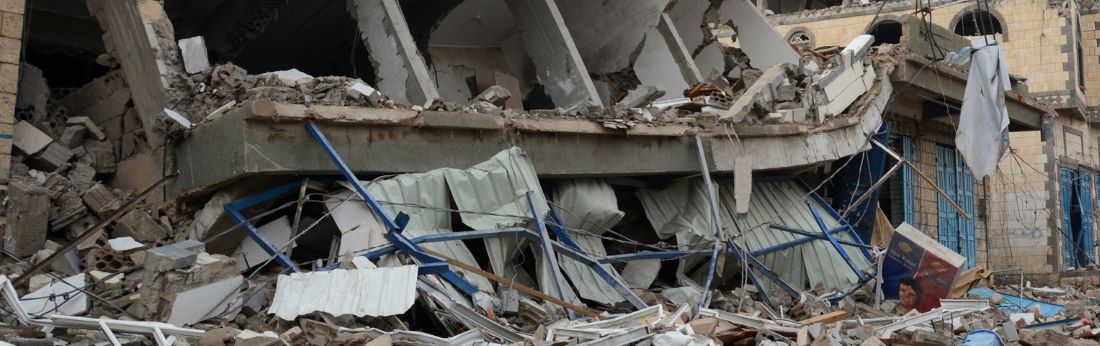
The building rescuers pulled me, my team, and 27 Yemeni survivors from after Saudi airstrikes in August 2018. Sa’ada, Yemen. Licensed under CC-BY-NC-ND 2.0
About Thinking Out Loud
Thinking Out Loud is a commentary series by Lara Kajs examining international law, humanitarian crises, and the prevention of mass atrocities. Drawing on field experience in conflict and displacement settings, the column explores the legal and policy challenges that shape contemporary conflicts.
About the Author
Lara Kajs is the founder and executive director of The Genocide Report, a Washington, DC-based educational nonprofit focused on atrocity prevention and international law. She is the author of several field-based books on conflict, displacement, humanitarian crises, and international humanitarian law, drawing on extensive research and field experience in Yemen, Syria, and Afghanistan. Her writing and public speaking focus on atrocity crimes, forced displacement, the protection of civilians, and the legal frameworks governing armed conflict.