By Lara Kajs
Thinking Out Loud
Regime change wars—military interventions designed to overthrow or replace a government—have been a recurring feature of international politics since the end of World War II. From Afghanistan in 2001, Iraq in 2003, to Libya in 2011, these operations are often justified as a path to stability, democracy, or humanitarian protection. Yet history demonstrates a stark truth: regime change wars rarely achieve their intended outcomes. Instead, they frequently produce instability, humanitarian crises, and long-term regional disruption.
The Complexity of Political Systems
Authoritarian and semi-authoritarian regimes are embedded in intricate political systems, including patronage networks, security apparatuses, military alliances, and informal power structures. Attempting to forcibly remove a regime often dismantles these networks, leaving society exposed to chaos.
Iraq illustrates this vividly. In 2003, U.S. planners expected that removing Saddam Hussein would pave the way for a democratic government. Instead, dismantling the central authority led to widespread sectarian violence, insurgency, and the rise of groups such as al-Qaeda in Iraq, eventually evolving into ISIS. Similarly, Libya’s 2011 intervention toppled Muammar Gaddafi but left the country fragmented among militias and warlords, creating a regional hub of instability.
Even in Venezuela, subtler interventions—through sanctions, covert operations, and support for opposition—have deepened political divisions, worsened economic collapse, and triggered mass migration. These examples highlight how even well-intentioned efforts to remove a regime can backfire, leaving civilians and the region at risk.
Removing a regime without understanding local realities often leaves a country in chaos, creating power vacuums that extremists and insurgents exploit.”
Power Vacuums and Misreading Local Contexts
One of the most predictable consequences of regime change is the creation of a power vacuum. When a central authority is removed, the structures maintaining stability collapse, and rival groups compete for control. Extremist factions frequently exploit these vacuums, intensifying instability
Afghanistan’s experience after the U.S.-led removal of the Taliban in 2001 demonstrates the danger of overlooking local complexities. Tribal divisions, ethnic dynamics, and weak centralized governance contributed to a prolonged conflict. Iraq’s sectarian divisions were similarly ignored following Saddam Hussein’s fall, while Libya’s institutions were too weak to absorb the shock of Gaddafi’s removal, leaving rival factions and extremist groups to compete for control over large parts of the country.
Venezuela provides a subtler illustration. External pressure assumed that removing Nicolás Maduro would restore democracy, yet the country remains polarized, with economic collapse and mass migration worsening internal strife. These examples demonstrate how interventions grounded in flawed assumptions about political, social, and cultural realities often backfire.
Long-Term Costs and Consequences
The human and financial toll of regime change wars extends far beyond the battlefield. In Afghanistan, nearly two decades of conflict resulted in tens of thousands of civilian deaths, millions displaced, and thousands of foreign soldiers killed. Before the final U.S. withdrawal in 2021, the Taliban had already regained control of much of the country, and by the time the last plane departed, they controlled all of Afghanistan.
In Iraq, more than 4,000 U.S. service members and hundreds of thousands of Iraqis lost their lives. Reconstruction efforts were plagued by corruption, inefficiency, and sectarian conflict, while ISIS capitalized on instability to seize territory. The long-term consequences in Libya were severe: with the central government dismantled, armed militias and extremist organizations filled the power vacuum, perpetuating instability and ongoing conflict.
Even in Venezuela, the consequences of external pressures are evident. Spillover effects have destabilized neighboring countries, fueled migration crises, and worsened organized crime and insurgent activity. Across all these cases, the predictable outcomes of regime change wars are stark: instability, human suffering, and long-term regional disruption.
Ethical and Legal Considerations
Regime change interventions raise fundamental ethical questions about sovereignty and the rights of nations to self-determination. International law, as articulated by the United Nations, generally prohibits external force to change governments. While interventions may be justified under humanitarian or counterterrorism rationales, historical outcomes suggest these justifications often result in more harm than good.
Using force for strategic or economic gain compounds civilian suffering and undermines international credibility, making interventions ethically indefensible.
Lack of Post-Conflict Planning
Perhaps the clearest reason regime change wars fail is the absence of coherent post-conflict strategies. Removing a regime is only the first step; rebuilding governance, security, and institutions is far more complex. Iraq and Afghanistan exemplify how inadequate post-war planning leads to insurgency, corruption, and systemic instability. Without clear reconstruction frameworks, countries can descend into cycles of violence that endure for decades.
Relevance to Current Policy Debates
The lessons of Iraq, Afghanistan, Libya, and Venezuela remain urgently relevant today. Policymakers weighing interventions in Iran, the humanitarian crises in Gaza, or continued pressure on Venezuela must understand the long-term consequences of regime-change wars. Without attention to local contexts, post-conflict planning, and international norms, even well-intentioned interventions risk worsening instability and human suffering.
Regime change wars, despite lofty promises of democracy and stability, have consistently failed to achieve their intended outcomes. Moving forward, international actors would be better served by prioritizing diplomatic solutions, peacebuilding, and institution-building rather than military-led interventions. Recognizing the human and strategic costs of intervention is essential for responsible foreign policy.
Published 17 October 2025
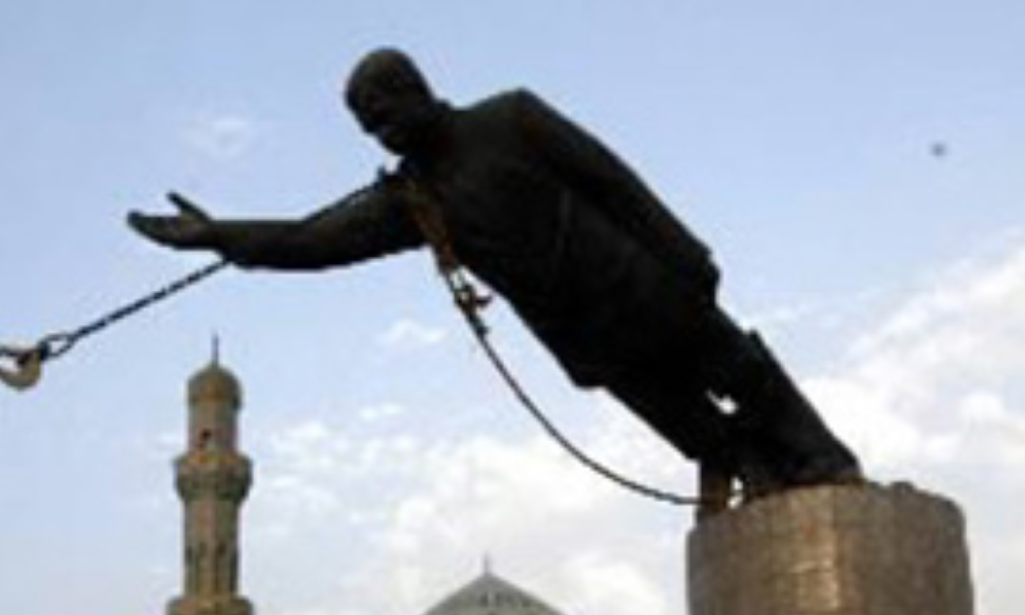
Photo credit: Firdos Square, Baghdad, Iraq – 9 April 2003. The toppling of the statue of Saddam Hussein signifies the end of the regime. (Kajs)
About Thinking Out Loud
Thinking Out Loud is a commentary series by Lara Kajs examining international law, humanitarian crises, and the prevention of mass atrocities. Drawing on field experience in conflict and displacement settings, the series explores the legal, political, and human realities that shape contemporary conflicts.
About the Author
Lara Kajs is the founder and executive director of The Genocide Report, a Washington, DC-based educational nonprofit focused on atrocity prevention and international law. She is the author of several field-based books on conflict, displacement, humanitarian crises, and international humanitarian law, drawing on extensive research and field experience in Yemen, Syria, and Afghanistan. Her writing and public speaking focus on atrocity crimes, forced displacement, the protection of civilians, and the legal frameworks governing armed conflict.